Work fleeces bobble quickly because they rub against seat belts, lanyards, desks, hi-vis layers, rucksacks and tool belts. The safest way to remove bobbles from work fleeces is to trim only the loose pills sitting on the surface, without shaving into the fleece pile itself. A careful approach keeps uniform tops looking tidy while reducing the risk of thinning elbows, cuffs and zip edges.
The assessment, repair or alteration of certified PPE workwear, including hi-vis or flame-resistant fleeces, is typically handled by the employer, supplier or a competent safety professional to maintain compliance with applicable UK workplace safety requirements and garment standards.
This guidance is for cosmetic bobble removal on ordinary work fleece and employer-approved uniform care. If your fleece has reflective tape, flame-resistant claims, antistatic markings or a safety standard label, treat those features as functional parts of the garment rather than decoration.
In brief
- Check the care label, employer uniform policy and any PPE markings before using a blade-based tool.
- Work on a clean, dry fleece laid flat on a firm surface.
- Use light pressure and short passes; never press a shaver into the fleece.
- Keep away from reflective tape, embroidered logos, badges, zip teeth, drawcords and seam ridges.
- Remove loose lint afterwards so the garment looks clean rather than freshly shaved.
- Stop if the fabric starts to look shiny, thin, laddered or flattened.
Why work fleeces bobble in the first place
Fleece is usually made from synthetic fibres, often polyester, which are brushed or raised to create a soft, insulating surface. That raised surface is useful for warmth, but it also gives fibres room to move. When the fabric rubs repeatedly, small loose fibres tangle into bobbles, also called pills.
Work fleeces have a harder life than casual weekend fleeces. Cuffs rub on desks and steering wheels, shoulders rub beneath outer jackets, and the lower front can abrade against belts, counters or equipment. Washing can add to the problem if the fleece is overloaded in the drum, washed with rougher garments, or dried with lint-shedding items.
Bobbles are not always a sign that the garment is ruined. On many uniform fleeces, they are mainly surface fibres and can be removed neatly. The key is knowing when you are tidying loose pills and when you are starting to damage the pile.
Check the fleece before you start
Lay the fleece on a table in good light and inspect it properly. A two-minute check helps you avoid the most common mistakes: shaving over logos, catching seams, or treating protective workwear as if it were an ordinary jumper.
Look for safety and uniform details
- Reflective tape: Do not shave over it. Bobbles beside tape should be removed by hand or with very cautious trimming away from the edge.
- Flame-resistant or antistatic labels: Follow the care label and employer instructions. If washing is also part of the issue, read the guidance on washing flame-resistant workwear without reducing protection.
- Embroidered logos and name panels: Keep blade tools away from raised stitching. Loose threads can be pulled or cut accidentally.
- Heat-applied badges: Avoid rubbing or shaving over printed transfers, vinyl logos or heat-sealed identification.
- Thin patches: If elbows, cuffs or the lower front already look worn, use a gentler method or leave them alone.
Check whether it is clean and dry
Debobble only when the fleece is completely dry. Damp fleece is more likely to drag under a shaver, and dirty fibres can clog the tool. If the garment smells stale, has food marks or is gritty from site work, wash and dry it first according to the label. Bobble removal should be a finishing step, not a substitute for cleaning.
Method one: use a fabric shaver carefully
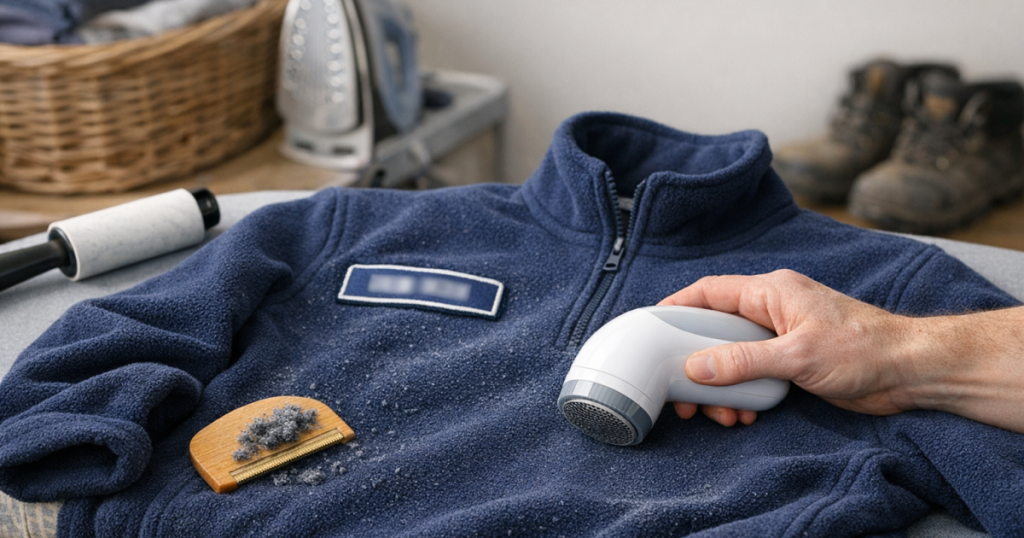
A fabric shaver is the fastest option for large bobbled areas such as sleeves, side panels and the front of a plain fleece. It works by trimming raised pills through a protective foil or guard. Used lightly, it can make a work fleece look much smarter; used aggressively, it can thin the pile and leave flat, shiny patches.
Choose a shaver with a clean cutting head and an intact guard. Empty the lint compartment before starting, because a full compartment can reduce performance and tempt you to press harder. If you are deciding whether this tool belongs in your uniform-care kit, our compact fabric shaver review explains what this type of gadget can and cannot fix.
Step-by-step
- 1. Zip the fleece up: Close the zip and fasten any hook-and-loop tabs so the garment sits flat.
- 2. Turn pockets flat: Smooth the pocket bags and plackets so the shaver does not catch a ridge underneath.
- 3. Place it on a firm surface: A table is safer than your lap. Put a clean towel underneath if the surface is slippery.
- 4. Test in a discreet area: Try a small section near an inside hem or lower side seam before treating visible panels.
- 5. Use gentle, floating passes: Move the shaver in short strokes over the bobbled surface. Let the tool skim the bobbles rather than dig into the fleece.
- 6. Work in sections: Finish one sleeve or panel before moving on. Check the fabric often under the light.
- 7. Avoid raised features: Stop several centimetres before logos, seams, tapes, badges, zips and drawcord channels.
- 8. Brush off loosened lint: Once finished, remove fluff with your hand, a garment brush or a reusable lint brush.
If the fleece starts to look flattened rather than simply cleaner, stop. Some pilling is better than a visibly shaved patch, especially on a uniform garment worn in front-of-house, site or customer-facing roles.
Method two: remove small bobbles by hand
For cuffs, collars, pockets and areas near workplace branding, a slower hand method is usually safer than a powered shaver. Use your fingers to lift larger pills gently, then trim only the bobble with small, sharp scissors. Keep the scissor blades parallel to the fabric surface and do not pull the bobble upwards hard, as that can draw more fibres out of the fleece.
A fine-toothed fabric comb can help on firmer fleece, but it needs care. Comb in one direction with light pressure and stop if the teeth start dragging the surface. Fleece with a soft, fluffy pile can become fuzzy or uneven if it is combed too strongly.
Hand removal is slower, but it is the better choice for issued uniform that has embroidery, contrast panels or decorative stitching. It also gives you more control on older fleeces where the fabric is still wearable but no longer robust.
Areas to treat with extra caution
Most debobbling damage happens where the fleece is uneven. A shaver is safest on flat, plain panels. Be much more cautious around anything raised, bonded or reinforced.
- Cuffs: Ribbed or elasticated cuffs can catch in a shaver. Stretch them gently over your hand or treat by hand instead.
- Zip edges: Keep the tool away from zip teeth and fabric guards. A caught zip edge can nick the fabric quickly.
- Shoulders: These often thin first because of bags and outer layers. Use fewer passes here.
- Reflective strips: Do not shave the strip or its edge. Damage can reduce reflectivity or cause lifting.
- Logos and names: Avoid stitched, printed and heat-applied branding. Work around them slowly by hand.
- Elbows: If the pile is already compressed or shiny, debobbling may make the wear more obvious.
What not to use on a work fleece
Some popular fabric hacks are too risky for workwear. A disposable razor can cut bobbles, but it has no proper fabric guard and can slice the pile, seams or stitching. Pumice stones and abrasive blocks can roughen fleece, particularly synthetic fleece, and may leave the surface uneven. Sticky tape can lift loose fluff but will not deal well with established pills, and repeated pulling is not ideal around printed logos.
A lint roller is useful after debobbling, not as the main bobble-removal tool. It removes loose fibres and pet hair but does not cut pills from the surface. For repeated uniform use, a reusable garment brush can be less wasteful than disposable sticky sheets; the differences are covered in our guide to reusable velvet lint brushes and sticky rollers.
Aftercare to slow the bobbles coming back
Once the fleece is tidy, adjust your routine so it stays that way for longer. You cannot prevent all pilling on a hard-working garment, but you can reduce the friction and lint that make it look tired.
- Wash inside out: This protects the outer surface from drum abrasion.
- Close zips and fasteners: Open zips, hook-and-loop tabs and buckles can scrape the fleece during washing.
- Separate rough items: Avoid washing fleeces with work trousers, towels or garments with heavy hardware where possible.
- Use a suitable cycle: Follow the care label. A gentler cycle may reduce rubbing for ordinary uniform fleece.
- Avoid overloading: A packed drum increases friction and can leave detergent residue trapped in the pile.
- Air dry properly: Hang or lay the fleece where air can circulate. Do not leave it bunched up while damp.
- Store without compression: Crushing fleece under heavy kit can flatten the pile and make worn patches look worse.
If several team fleeces bobble badly after only a few wears, the issue may be fabric quality, sizing, laundering conditions or how the garments are being used. For example, a fleece worn daily beneath a stiff outer jacket will usually pill faster at the shoulders than one worn as a top layer in an office or reception setting.
When to stop debobbling and replace the fleece
Debobbling improves appearance, but it cannot restore lost fibre. A fleece may need replacing if it has thin elbows, damaged seams, a misshapen hem, broken zips, lifting reflective tape or surface wear that makes it look patchy even after cleaning.
For employer-issued workwear, do not keep shaving a garment to make it last beyond its useful life. A neat-looking fleece still needs to meet the expectations of the workplace, and any protective features need to remain intact. If the fleece is part of a safety system, replacement decisions should follow the employer’s workwear process rather than home judgement alone.
Common questions
Can I use a normal razor on a work fleece?
It is not the safest choice. A normal razor can cut the pile, nick seams and catch logos or tape. A guarded fabric shaver or careful hand trimming gives better control.
How often should I debobble a uniform fleece?
Only when the bobbles are visible enough to affect appearance. Frequent shaving removes small amounts of fibre each time, so it is better to do light maintenance occasionally than heavy shaving every wash.
Is it safe to debobble hi-vis fleece?
You can tidy plain fleece areas if your employer allows it, but do not shave reflective tape, printed markings or certified safety panels. Damaged reflective areas should be assessed through the proper workplace process.
Why does my fleece look patchy after shaving?
Patchiness usually means the pile has been thinned, flattened or shaved unevenly. Stop treating that area and brush the surface lightly to lift loose fibres, but avoid repeated shaving to correct it.
Can bobbles be removed before washing?
Yes, if the fleece is clean and dry. If it is dirty, gritty or damp, wash and dry it first so the shaver or comb moves smoothly over the surface.
What stands out
The safest bobble removal is controlled and conservative. Treat plain fleece panels lightly, avoid functional workwear details, and stop before the fabric starts to look worn. With a clean garment, a steady surface and the right level of pressure, you can make a tired work fleece look smarter without shortening its useful life unnecessarily.