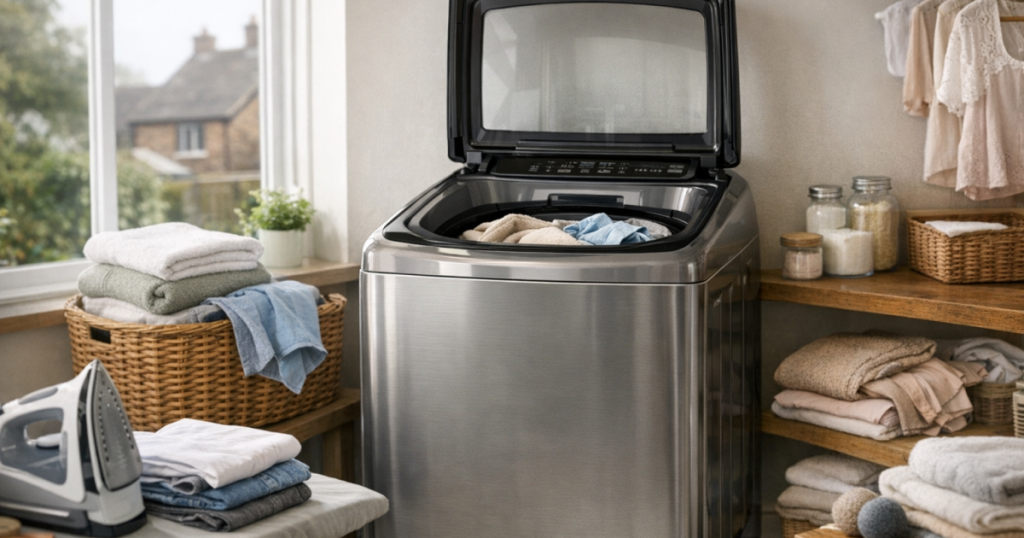
A top loader can be tempting if bending to unload a front-loading machine is awkward, or if you want a wide opening for towels, bedding and uniforms. This Samsung top load washing machine review looks at the real fabric-care and home-laundry questions UK buyers should ask before choosing one, including fit, wash action, drying impact, warranty support and long-term practicality.
Mains electrical connection, plumbing alterations and fault diagnosis involving leaks or wiring should be handled by a qualified professional to meet UK safety requirements, building standards and manufacturer installation instructions.
The short version
Samsung top load washing machines can make sense for some households, but they are not the default choice for most UK kitchens and utility rooms. Samsung’s mainstream GB washing machine range is heavily focused on front loaders, while top loaders are more often seen through overseas catalogues, specialist retailers or import listings. That does not make them unsuitable, but it does mean the buying checks matter more than usual.
- Best fit: utility rooms, garages and laundry spaces where the lid can open fully and the machine does not need to sit under a worktop.
- Main advantage: easier loading from above, useful for towels, sports kit, school uniform and family laundry baskets.
- Main drawback: model support, parts, warranty terms and energy labelling need careful checking for the UK market.
- Fabric-care concern: the wash action and cycle choice vary by model, so woollens, delicates and structured garments need extra caution.
- Verdict: worth considering for accessibility and high-volume everyday laundry, but a Samsung front loader will usually be the safer UK choice for broad availability, under-counter fitting and familiar service support.
How Samsung top loaders differ from typical UK front loaders
A top load washing machine opens from above rather than the front. That changes more than the loading position. It affects where the machine can go, how you sort laundry, how you unload wet clothes, and how easily you can use the top surface for storage.
Most UK kitchens are designed around front-loading machines that slide under a worktop. A Samsung top loader normally needs clear space above the lid, so it is better suited to a utility room or open laundry corner. If your washing machine currently lives beneath a counter, a top loader is unlikely to be a straightforward swap.
The wash mechanism also matters. Some top loaders use a central agitator, while others use a low-profile impeller or pulsator-style base. Samsung models vary by market, so do not assume every machine treats clothing in the same way. For fabric care, check the user manual for the exact model and look for cycle names, temperature options, spin settings and guidance for wool, synthetics and delicates.
Step 1: Check the exact model, not just the Samsung badge
This is the most important part of the buying process. A listing titled “Samsung top loader” is not enough. Find the full model code, then check the manufacturer documentation, retailer warranty page and aftercare route before paying.
Real Samsung top-loading models you may see in international or import listings include Samsung WA90T5260BY and Samsung WA80T5160WW. Treat those as examples of model codes to investigate, not as a guarantee of UK stock, specification or support. Retailer descriptions can be incomplete, and the same broad series may have different features in different regions.
- Confirm GB warranty support: check who handles repairs, whether Samsung UK supports that exact model, and whether parts are obtainable locally.
- Check the plug and voltage information: imported appliances must be suitable for normal UK household use and properly supplied.
- Read the full manual: look for wash temperatures, detergent drawer layout, cleaning instructions and cycle limits.
- Ask about returns: large appliances can be expensive and awkward to return once unpacked or connected.
- Look for a GB energy label or clear equivalent information: do not rely on vague “efficient” claims in marketplace listings.
Step 2: Measure the laundry space properly
Top loaders are often bought for convenience, then become frustrating because the lid cannot open comfortably. Measure width, depth and height in centimetres, but also measure the usable clearance above the machine. Wall cabinets, shelves, boilers, sloping ceilings and worktops can all make a top-opening lid awkward.
Leave room to stand in front of the appliance with a full basket. If the machine is in a narrow utility space, check whether you can lift out wet towels without scraping your knuckles or dropping items behind the appliance. Wet laundry is heavier than dry laundry, and that matters if the drum is deep.
Floor type is another practical point. A machine spinning a full load of towels or bedding needs a stable, level surface. Suspended timber floors can amplify vibration, particularly in upstairs flats and older homes. Use the levelling feet correctly, avoid squeezing the machine tightly against cabinets, and follow the installation clearances in the manual.
Step 3: Judge the wash action by the clothes you actually own
A Samsung top loader may be perfectly acceptable for robust everyday loads: cotton T-shirts, pyjamas, towels, cleaning cloths, bedding, PE kit and many school uniform items. The bigger question is how often you wash garments that dislike friction, twisting or long wet cycles.
Be more cautious with merino base layers, wool jumpers, viscose dresses, lace-trimmed underwear, tailored trousers, bras, embellished tops and anything labelled hand wash or dry clean only. A generous drum opening is useful, but it does not automatically make the machine gentler.
Use these checks before trusting delicate garments to any top loader:
- Cycle control: can you choose a short, low-agitation or delicate programme?
- Spin adjustment: can you reduce spin speed for crease-prone or stretch-sensitive fabrics?
- Temperature accuracy: are the wash temperatures clearly stated rather than described only as warm or hot?
- Load movement: does the manual warn against washing waterproofs, bulky items or delicate fabrics in certain modes?
- Detergent dosing: can you dose accurately for soft, medium or hard water and avoid residue on dark clothing?
For knitwear, machine choice is only one part of the care routine. Even after a careful wash, jumpers can stretch badly if hung while wet, so it is worth following a proper flat-drying method for wool and heavy knits. See how to dry jumpers flat without stretching them if your laundry includes woollens or chunky winter layers.
Step 4: Think about water use, drying time and indoor laundry
Top loaders can use water differently from front loaders, and the exact amount depends on the model, load sensing and selected programme. UK households on a water meter should look carefully at programme information rather than assuming a large drum is automatically economical.
Spin performance is also important because it affects drying. A load that comes out wetter will take longer on an airer, increase room humidity and raise the chance of musty odours in winter. This is particularly relevant in flats, smaller homes and properties where laundry dries indoors for much of the year.
If you regularly dry washing inside, pair any washing-machine choice with a sensible drying setup: good spacing on the airer, ventilation, prompt unloading and humidity control. The practical steps in stopping clothes smelling damp on an airer are just as important as the washing programme itself.
Where a Samsung top loader works well
The strongest argument for this style of machine is ease of loading. If you dislike crouching, have limited mobility, or regularly transfer large armfuls of laundry, top access can be more comfortable. It can also be handy in a dedicated laundry area where the machine is freestanding and the top is not needed as a work surface.
For a busy household, a top loader may suit robust mixed laundry: towels, cotton bedding, sportswear, children’s clothes and casual basics. The lid opening makes it easy to load bulky items, though you still need to follow the manual’s limits for duvets, bath mats and heavy absorbent pieces.
Another benefit is that top loaders do not have the same large front door seal as many front loaders. That can reduce one common place where water sits after use, although it does not remove the need for regular cleaning. Lids, detergent areas, filters and the drum still need airing and maintenance.
Where it may frustrate UK buyers
The first frustration is placement. A top loader will not suit most under-counter kitchen spaces. If the only available spot is beneath a worktop, a front loader is the practical answer.
The second issue is support. A model that is common in another country may be harder to repair quickly in Great Britain. Before buying, check whether the retailer provides UK-based aftercare and whether consumable or replacement parts can be ordered without long delays.
The third issue is delicate care. Many UK buyers choose modern front loaders because they offer familiar wool, hand-wash, quick wash, mixed load and low-temperature programmes. Some Samsung top loaders may offer useful fabric programmes too, but you must verify them on the exact machine rather than relying on general brand reputation.
Maintenance checks after purchase
If you do choose a Samsung top loader, the care routine is straightforward but should be consistent. Leave the lid open after washing so moisture can escape. Wipe the rim and detergent area, remove lint where the manual instructs, and run the recommended drum-cleaning cycle at the stated interval.
Avoid overfilling. Clothes need room to move, rinse and spin correctly. Overloading can leave detergent marks, lint, creasing and damp patches in dense items. It can also make drying slower, which is where many fabric-care problems begin.
Use detergent according to the load size, soil level and local water hardness. More detergent does not mean cleaner clothes; it can leave residue that makes fabrics feel stiff, attracts lint and traps odours. For households drying indoors, a dehumidifier can help control moisture after washing, and the advice on using a dehumidifier when drying laundry indoors explains how to place and run one sensibly.
The big picture
A Samsung top load washing machine is not a bad idea, but it is a more specialist choice for UK homes than a standard front loader. It earns its place when the loading height, open-top access and family-laundry convenience solve a real problem in your home. It becomes risky when the exact model, warranty route, dimensions and fabric programmes are unclear.
For most UK buyers, the best approach is simple: choose by model code, not by brand name alone. Confirm support, measure the space, read the manual, and judge the machine against the garments you wash most often. If your laundry is mostly tough cottons, towels and bedding, a top loader may work well. If your wardrobe includes wool, viscose, delicates, uniforms that must stay smart, or clothes that need low-spin care, a well-supported front loader may be the more versatile option.
FAQ
Are Samsung top load washing machines widely available in the UK?
They are less common than Samsung front loaders in the GB market. Some may appear through specialist or import retailers, so always verify UK warranty, delivery, returns and repair support before buying.
Is a top loader gentler on clothes than a front loader?
Not automatically. Gentleness depends on the wash mechanism, programme design, spin options and how you load the drum. Check the manual for wool, delicate and low-spin settings.
Can a Samsung top loader fit under a kitchen worktop?
Usually no. The lid opens upwards, so it needs clear overhead space. It is normally better suited to a utility room, garage laundry area or open freestanding position.
Will a top loader make indoor drying harder?
It can do if the selected programme leaves clothes wetter than your current machine. Compare spin options and avoid overloading, as wetter laundry takes longer to dry and can smell musty on an airer.
Should I buy one for wool jumpers and delicate clothes?
Only if the exact model has suitable delicate or wool programmes and adjustable spin settings. For valuable knitwear, hand washing or a proven gentle front-loader cycle may be safer.