Flame-resistant jackets, trousers and coveralls are protective workwear, not ordinary laundry. If you need to wash flame-resistant workwear at home, the safest routine is label-led, residue-free and strict about contamination.
Many FR garments can be laundered successfully, but the wrong products or shortcuts can leave flammable residues, damage treated finishes or hide wear that should be assessed before the garment goes back into use.
Inspection, repair, re-certification and deciding whether damaged or contaminated flame-resistant PPE can return to hazardous work are safety-critical tasks that should be handled by a qualified PPE provider or the employer’s competent safety lead in line with UK workplace safety requirements and the garment’s stated standards.
What to know first
- Follow the care label and employer laundering policy before any general laundry rule.
- Wash FR garments separately from normal household laundry where possible, especially if they are visibly dirty or work-contaminated.
- Avoid chlorine bleach, fabric conditioner, starch, waxy stain products and anything that leaves a coating on the fabric.
- Deal with oil, fuel, grease, paint, solvent and chemical contamination seriously; washing does not automatically make the garment safe again.
- Dry fully before storage or reuse, because damp workwear can smell, mildew and make inspection harder.
Why washing method matters for FR protection
Flame-resistant workwear is designed either with fibres that are inherently flame resistant or with a flame-retardant treatment applied to the fabric. In both cases, the protective performance depends on the fabric remaining clean, intact and free from residues that could ignite or interfere with the garment’s intended behaviour.
The biggest laundry risks are not usually a single normal wash. Problems tend to come from repeated use of unsuitable additives, heavy contamination, aggressive bleaching, very high heat when the label does not allow it, or continuing to wear garments that are worn thin, torn or impregnated with flammable substances.
Common FR garments in UK workplaces may reference standards such as EN ISO 11612 for heat and flame, EN ISO 11611 for welding-related clothing, EN 1149 for electrostatic properties or EN ISO 20471 for high-visibility clothing. The standard on the label does not tell you how to wash it by itself, but it does remind you that the garment is part of a protective system, not just a uniform.
Step 1: read the label and laundering instructions
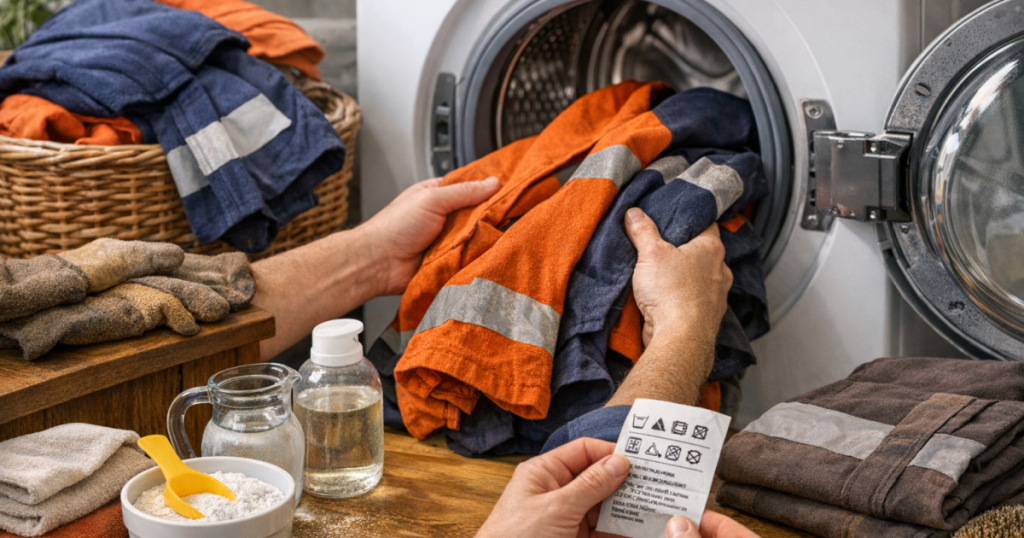
Start with the garment label, not the washing machine dial. Look for the maximum wash temperature, drying symbol, ironing limit, number of permitted industrial washes if stated, and any warnings such as “do not bleach” or “do not use fabric conditioner”.
If the garment has company-issued instructions, follow those as well. Some employers specify professional laundering because they need controlled washing, traceability, repair records or contamination handling. Domestic washing is not automatically wrong, but it is not suitable for every workplace risk.
Also check whether the garment combines several protective elements. For example, a flame-resistant hi-vis jacket may have reflective tape, FR outer fabric, a lining, storm cuffs and fasteners. The most delicate component often dictates the wash method.
Step 2: separate FR workwear before washing
Do not wash flame-resistant clothing with towels, fleece, oily overalls, heavily perfumed laundry or normal casual clothing. Mixed loads increase the chance of lint, residues and contamination transferring onto protective fabrics.
Separate by colour, soil level and garment type. A lightly worn FR polo shirt does not need the same handling as trousers with grease marks or a jacket used near welding spatter. Empty pockets thoroughly, remove loose debris and shake out dust outside where appropriate.
Close zips, press studs and hook-and-loop fasteners before washing. This reduces abrasion and helps protect reflective tape and surface finishes. Turn garments inside out if the label allows it, especially where the outer face has printed logos, reflective panels or areas prone to rubbing.
Step 3: pre-treat stains without leaving risky residues
Stains on FR workwear are not only cosmetic. Oil, fuel, grease, resin, paint and solvent-based marks can affect safety because some contaminants are flammable or may change how heat transfers through the fabric.
For ordinary mud, food or sweat marks, use a small amount of suitable liquid detergent and gently work it into the area before washing. Avoid solvent spot removers, waxy stain sticks, chlorine bleach and products that leave a water-repellent or softening film unless the garment manufacturer explicitly permits them.
If a garment smells of fuel, has oily patches that remain after washing, or has been exposed to unknown chemicals, remove it from normal wear and escalate it through the workplace PPE process. Do not keep washing repeatedly in a domestic machine and assume the problem has gone because the surface looks cleaner.
For white uniforms, the temptation is to brighten with stronger products, but FR clothing needs more caution than cotton catering kit. For non-FR white work garments, our advice on how to keep chef whites bright without harsh bleach explains gentler whitening habits; for FR whites, the garment label still takes priority.
Step 4: choose a simple detergent routine
Use a regular detergent only if it is permitted by the care label and workplace guidance. The aim is effective soil removal without additives that coat the fibres. In practice, that means avoiding fabric conditioner, fragrance boosters, starch, water-repellent sprays, silicone-based treatments and laundry products marketed primarily for softness or scent.
Powder or liquid can both be acceptable depending on the garment instructions and your machine, but rinse performance matters. Too much detergent can leave residue, while too little may fail to remove oily soil. Dose for load size, local water hardness and soil level rather than using a generous “just in case” amount.
Do not use chlorine bleach on FR workwear unless the manufacturer specifically states that a particular bleaching process is allowed. Chlorine can weaken fibres, affect finishes and damage reflective or high-visibility components. Oxygen-based products also need checking rather than assuming they are safe for every FR fabric.
Step 5: set the wash cycle correctly
Choose the wash temperature shown on the label. Higher heat is not automatically better; it may shrink some components, damage trims or reduce the life of treated finishes. Lower heat may be fine for lightly soiled garments, but it may not remove heavy sweat, grease or workplace soil effectively.
A normal or easy-care cycle is often more appropriate than an aggressive heavy-duty cycle, unless the care label allows robust laundering. Avoid overloading the drum. FR garments need room to move so detergent can reach dirty areas and rinse away fully.
Use an extra rinse if detergent residue is a recurring issue or if garments feel stiff, slippery or overly scented after washing. Residue is not just uncomfortable; coatings and build-up can compromise how protective fabric behaves.
Step 6: dry without overheating or trapping damp
Drying instructions matter as much as washing instructions. Some FR garments can be tumble dried on a specified setting, while others should be line dried or dried flat. Follow the label, especially where garments include reflective tape, waterproof layers or heat-sensitive trims.
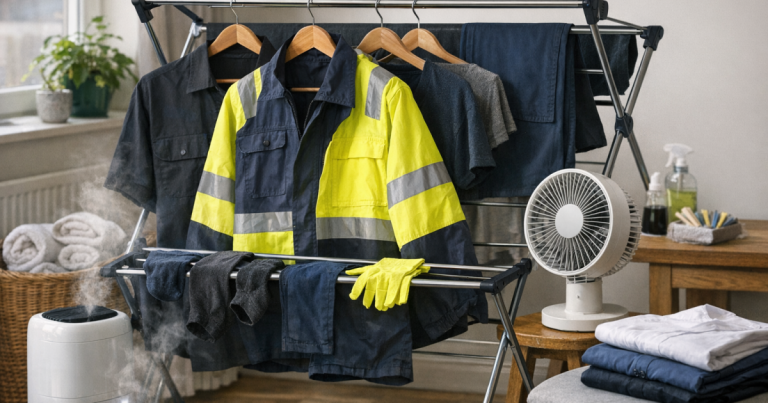
Do not dry FR workwear over direct heat such as a radiator, heater or stove. Localised high heat can damage fibres and trims, and it can set stains that should have been removed first. If drying indoors, use airflow rather than heat alone, and do not pack heavy garments tightly together.
Workwear that dries slowly can develop musty odours, particularly in UK homes during wet months. If indoor drying is unavoidable, spacing garments well and managing humidity matters; our guide to stopping air-dried clothes smelling damp indoors covers the airflow and drying habits that help prevent stale odours.
Step 7: inspect before putting it back into service
Clean does not always mean safe. Once the garment is dry, inspect it in good light before it goes back into a locker, van or work bag.
- Check for holes, worn patches, thinning fabric, burns, melted areas or broken seams.
- Look at cuffs, knees, elbows, pockets and hems, as these areas take the most abrasion.
- Inspect reflective tape for lifting, cracking, heavy staining or loss of reflectivity.
- Check fastenings so the garment can be closed properly during use.
- Smell the garment for lingering fuel, solvent, smoke or chemical odours.
Repairs should use compatible FR fabric, thread and components. Ordinary sewing thread, non-FR patches or standard iron-on mending products can create weak points. For issued PPE, repairs normally need to go through the employer or approved supplier rather than being done as a home sewing job.
Special cases: hi-vis, welding gear and structured work jackets
FR hi-vis clothing
High-visibility FR garments need both flame resistance and visibility to be maintained. Dirt, dye transfer and cracked reflective tape can reduce visibility even if the base fabric is still intact. Wash hi-vis items with similar colours and avoid products that dull or coat reflective materials.
Welding and metalwork garments
Clothing used around welding spatter, grinding dust or hot metal needs careful inspection for small burns and embedded debris. Brush off dry debris before washing and pay attention to cuffs and pockets where particles can collect. If the garment has burns or hard, shiny, melted-looking areas, remove it from service for assessment.
Structured work jackets and uniform-style pieces
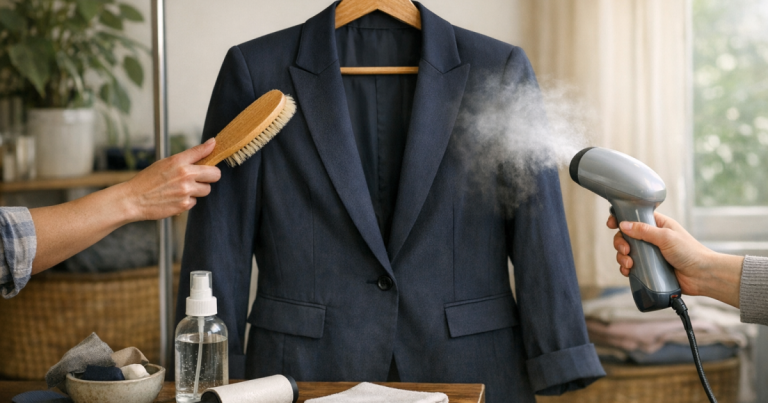
Some protective jackets and blazers have shoulder structure, linings or shape-retaining panels. Do not wring them out or hang them on thin wire hangers while wet, as this can distort the shape. The same shaping principles used to wash school blazers without losing their shape can help with non-PPE uniform jackets, but FR-rated garments still need their own care label followed first.
Finishing, ironing and storage
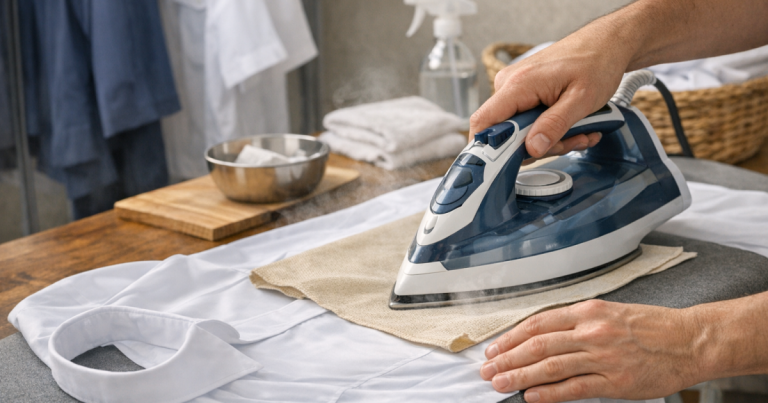
Only iron FR workwear if the care label allows it, and use the stated temperature limit. Never use starch to create a sharper finish. Starch and sizing products can form combustible coatings and are a common reason protective clothing guidance tells users to avoid “crisping up” workwear like ordinary shirts.
Be careful with reflective tape, printed logos and heat-transfer badges. Use a pressing cloth if the label permits ironing and avoid prolonged pressure on trims. For non-protective uniform items, our guide to choosing between steamers and irons explains when steam is gentler than pressing; for FR garments, only use steam or ironing where the manufacturer allows it.
Store garments clean, dry and away from chemicals, fuel, oils and direct sunlight. Do not leave FR workwear screwed up in a van footwell, damp changing room or workshop corner. Good storage prevents contamination and makes damage easier to spot before the next shift.
Things readers ask
How often should I wash flame-resistant workwear?
Wash it when it is dirty, sweaty, contaminated or as required by your employer’s PPE policy. Do not let grease, oil, dust or chemical residues build up between washes.
Can I use fabric conditioner on FR clothing?
No, not unless the garment manufacturer explicitly allows it. Fabric conditioner can leave residues that may affect flame-resistant performance and can also interfere with moisture and visibility features.
Is domestic washing safe for all FR garments?
No. Some FR items are suitable for home laundering, while others need controlled professional laundering because of contamination, workplace rules or certification requirements. Follow the garment label and employer instructions.
What should I do if oil stains remain after washing?
Do not wear the garment for hazardous tasks. Persistent oil or fuel marks should be treated as a safety issue and assessed through the workplace PPE process.
Can FR workwear shrink?
It can, depending on the fabric, construction and wash temperature. Use the labelled temperature, avoid excessive heat and check fit after laundering because protective clothing must cover the body properly.
Final thoughts
The safest laundry routine for flame-resistant workwear is simple but disciplined: read the label, wash separately, use detergent without coating additives, dry according to instructions and inspect every garment before reuse. The point is not just to make workwear look presentable, but to keep protective fabrics clean, intact and free from substances that could reduce protection.
If the garment is damaged, contaminated or no longer fits as intended, laundering is not the fix. Take it out of circulation and have it assessed through the correct workplace route before relying on it again.