Indoor laundry dries best when damp air has somewhere to go. The aim is to position a dehumidifier so it can pull moisture from the whole drying area, not just one damp corner. Good placement also helps reduce musty smells, window condensation and the stiff, slow-dried feel that can affect towels, uniforms and heavier cottons.
For most UK homes, the right setup is a small, enclosed room, a well-spaced airer and a dehumidifier placed close enough to the washing to catch moisture without blocking airflow or sitting under dripping garments.
The short version
- Place the dehumidifier in the same room as the laundry, ideally around 1 to 2 metres from the airer.
- Keep doors and windows closed while it runs, unless the appliance manual says otherwise.
- Leave clear space around the air intake and outlet; do not push it tight against a wall, curtain or sofa.
- Spread clothes out on the airer so humid air can move between garments.
- Avoid placing the machine directly underneath wet laundry where drips could fall onto it.
- Use a smaller enclosed room rather than a large open-plan space whenever possible.
Why placement matters when drying laundry
A dehumidifier dries laundry by removing water vapour from the air. As clothes release moisture, the surrounding air becomes humid. The machine draws that air in, condenses or absorbs moisture depending on its type, and returns drier air to the room. The drier the surrounding air, the more readily water can evaporate from fabrics.
Placement affects three things: how quickly humid air reaches the machine, how well dry air circulates back around the clothes, and whether the room itself stays controlled. A dehumidifier hidden behind furniture or placed too far from the airer may still collect water, but it will not work as efficiently for the laundry itself.
This is why the best indoor drying results usually come from treating the airer, machine and room as one setup. It is not enough to switch the appliance on in the corner and hope for the best. You want moisture to move away from the clothes, pass through the dehumidifier, and return as drier air without dead zones.
Step 1: choose the right room first
Start with the room before you decide the exact spot. A small spare bedroom, box room, utility room or closed-off dining room usually works better than a large open-plan kitchen-living area. The smaller the air volume, the easier it is for the dehumidifier to lower humidity around the laundry.
Close internal doors while drying. Open windows usually work against the appliance because fresh damp air keeps entering, especially on wet or cold days. In mild dry weather, window ventilation can be useful for ordinary air drying, but when you are relying on a dehumidifier, a closed room is usually more effective.
Avoid very cold rooms if you can. Laundry will release moisture more slowly in a chilly space, and some dehumidifier types are less effective at lower room temperatures. A modestly warmed room can help, but do not place clothes directly on radiators; that can cause uneven drying, stiffness and localised moisture on walls and windows.
Step 2: place the dehumidifier beside, not under, the airer
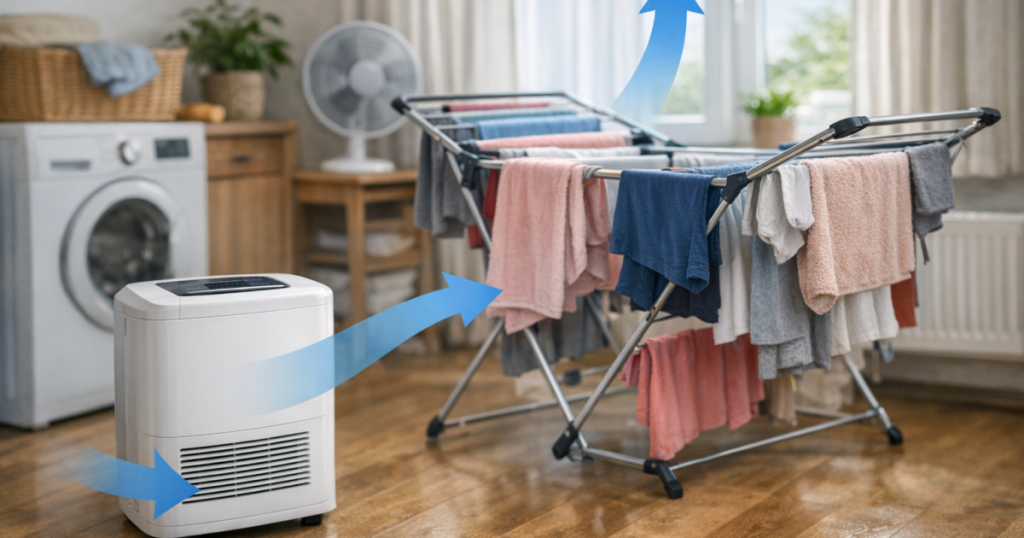
The ideal position is close to the laundry, but not directly beneath it. In many homes, that means placing the dehumidifier on the floor beside the airer, with the air outlet angled towards or across the clothes if the appliance design allows it.
As a working rule, keep it around 1 to 2 metres from the airer. This is close enough to capture humid air but far enough to avoid wet sleeves, towel corners or bedding dripping onto the machine. Always follow the manufacturer’s stated clearance guidance, because airflow design varies between models.
Do not put the appliance inside the airer, tucked between hanging clothes, or boxed in by bedding. It needs free air movement to work properly. If your airer is loaded with towels, hoodies or jeans, leave a clear channel of space between the damp items and the dehumidifier so air can circulate rather than hitting a fabric wall.
Step 3: leave clear airflow around the machine
A dehumidifier needs space at both the intake and outlet. The intake is where moist air is drawn in; the outlet is where drier air is released. If either side is blocked by a wall, curtain, laundry basket or sofa, the machine may cycle inefficiently and the room will dry unevenly.
Check your appliance manual for the minimum clearance, then use that as the rule for your room. If you no longer have the manual, a cautious approach is to leave generous open space around every vent and avoid placing the unit tight into a corner.
The airer matters too. A winged airer often works well because garments can be spread across different levels with gaps between them. If your current airer leaves clothes bunched together, our 20m winged airer review explains why layout and usable rail space can make everyday indoor drying less frustrating.
Step 4: load the airer with airflow in mind
Dehumidifier placement will not fully compensate for an overloaded airer. If garments are touching in thick layers, moisture becomes trapped between fabrics and drying slows down. Heavy items should be given the most open space, while lighter garments can sit on inner rails or higher points where air moves freely.
Use these simple loading habits:
- Hang towels over two rails instead of folding them tightly over one.
- Place thicker cottons, hoodies and jeans on the outside edges of the airer.
- Keep shirts and school uniform pieces separated so collars, cuffs and linings dry properly.
- Shake garments out before hanging to open seams and reduce deep creases.
- Turn heavy items part-way through drying if one side remains cool or damp.
If you are mixing indoor air drying with machine drying, avoid transferring crumpled piles straight from washer to dryer or airer. For tumble-dried loads, the same spacing principle applies; our guide on how to load a tumble dryer without creasing clothes is useful when you want faster drying without setting in wrinkles.
Step 5: match the position to the room layout
Small spare bedroom
Put the airer near the centre of the room if space allows, with the dehumidifier to one side and the door closed. Avoid pushing the airer hard against an outside wall, where cold surfaces can encourage condensation behind garments. If the room has wardrobes, keep damp laundry away from them so moisture does not collect around stored clothes.
Utility room
A utility room can work very well because the laundry workflow is already there. Position the appliance away from sinks, dripping garments and splash-prone areas. If the room is narrow, face the outlet down the length of the room rather than into a nearby wall.
Bathroom
Only use a dehumidifier in a bathroom if the product instructions say it is suitable for that environment and it can be positioned safely away from water sources. Many people dry laundry over the bath, but this can be awkward because the best dehumidifier position may also be the least convenient for electrical safety and airflow. A spare room is usually the more practical choice.
Open-plan living space
Open-plan rooms are harder because the appliance is trying to dry a much larger volume of air. If you must use one, place the airer and dehumidifier close together in a defined area, away from cooking steam and open external doors. Expect drying to take longer than it would in a smaller closed room.
Step 6: avoid common placement mistakes
The most common mistake is putting the dehumidifier where it looks tidy rather than where air can move. A neat corner behind the airer may be convenient, but it can leave the front of the laundry drying faster than the back. Another mistake is opening a window “to help it breathe” while the appliance is running. In damp British weather, this often keeps feeding moisture back into the room.
Avoid these setups:
- Directly below wet clothes, especially towels, bedding or hand-washed garments that may drip.
- Pressed against a wall, curtain, bed base or sofa.
- Inside a wardrobe, cupboard or cramped alcove.
- On an unstable surface or where the cable becomes a trip hazard.
- Next to a radiator blasting heat onto delicate fabrics.
- In a room where clean dry clothes, wool coats or stored textiles are exposed to lingering damp.
Once laundry is fully dry, put it away promptly. Clothes that feel “nearly dry” can still hold moisture in waistbands, cuffs, seams and linings. That matters for seasonal garments and knitwear in particular; our long-term clothes storage guide explains why fabrics should be clean and completely dry before being packed away.
Fabric-aware drying checks
Different fabrics respond differently to indoor drying. Cotton towels and bedding release a lot of moisture, so they need more space and longer running time. Synthetic sportswear may dry quickly but can hold odour if left bunched up. Wool and cashmere should be dried flat where possible, away from direct heat and strong concentrated airflow that could distort the shape.
For shirts, blouses and school uniform, the main issue is creasing and seams. Shake each garment out, smooth plackets and collars by hand, and hang with space between items. If you plan to iron afterwards, remove garments when they are fully dry but not left sitting for hours in a stiff pile.
For delicates, use the dehumidifier to improve the room conditions rather than trying to blast air directly at the garment. Lay items flat on a clean drying mesh or towel where suitable, reshape them gently, and check care labels before using any heat-assisted drying method.
How to tell whether the position is working
You do not need specialist equipment to judge the setup, although a simple room humidity reading can be helpful. The main signs are practical: windows should show less condensation, the room should feel less clammy, and clothes should move from wet to cool-damp to dry in a steady way.
After the first hour, check the room. If the area behind the airer feels much damper than the area near the machine, rotate the airer or move the dehumidifier so air travels across the load more evenly. If the appliance seems to be collecting water but clothes remain damp in thick patches, the airer is probably overloaded or the heaviest items need turning.
A good indoor drying position should feel controlled rather than forced. You are not trying to heat the clothes aggressively; you are lowering the humidity around them so moisture can leave the fibres at a sensible pace.
Common questions
Should the dehumidifier face the wet clothes?
If the outlet direction can be adjusted, facing dry air across the airer can help. Do not place it so close that garments block the vents or drip onto the appliance.
Is it better to put the dehumidifier high up or on the floor?
Most household dehumidifiers are designed to sit on a stable floor. Use the appliance as instructed and prioritise clear intake and outlet space over height.
Should windows be open when drying laundry with a dehumidifier?
Usually no. Keep windows and internal doors closed so the machine dries the room air instead of constantly dealing with new outdoor moisture.
Can a dehumidifier damage clothes?
Used sensibly, it should not damage everyday laundry because it dries the air rather than applying direct heat. Take extra care with wool, cashmere, silk and structured garments, and follow their care labels.
How close is too close?
If clothes can touch the appliance, block a vent or drip onto it, it is too close. Keep a clear gap and use the manufacturer’s clearance guidance as the minimum.
What stands out
The most effective laundry drying setup is simple: a closed room, a spaced-out airer and a dehumidifier placed beside the load with clear airflow on all sides. Keep the machine close enough to manage the damp air, but not so close that wet fabric interferes with it. Once you get the layout right, indoor drying becomes less about guesswork and more about a repeatable routine that protects both your clothes and your home environment.