Shoulder peaks usually come from hanging soft, heavy or narrow-necked garments on hangers that are too thin, too short or too sharply ended. Choosing hangers that stop shoulder bumps is less about buying the thickest option and more about matching shape, width and surface to the garment.
The aim is simple: the hanger should support the garment where a body would, not push into one small point at the sleeve head. A good hanger spreads weight, lets the shoulder line relax naturally and suits the fabric’s tendency to stretch, slip or crease.
The short version
- For shirts and blouses, choose a hanger that reaches close to the shoulder seam without poking beyond it.
- For heavier knitwear, avoid hanging where possible; fold it or use shelf storage instead.
- For jackets, coats and structured pieces, use a broad, contoured hanger that supports the shoulder shape.
- For viscose, satin and silky fabrics, prioritise smooth surfaces and gentle grip rather than rough or sharp edges.
- For small wardrobes, slim hangers are useful, but they still need rounded ends and enough width for the garment.
If your wardrobe mixes work shirts, jumpers, uniforms and delicate occasionwear, it helps to sort pieces by fabric and use before changing hangers. The approach in this wardrobe organisation guide works well before you invest in a new set.
Step 1: check where the shoulder seam sits
Take a garment that often develops bumps and lay it flat. Look for the shoulder seam, not just the widest point of the fabric. The hanger ends should sit just inside or very close to that seam; if they stop too far inwards, the sleeve head carries the weight and a peak forms. If they extend beyond the seam, the hanger can distort the sleeve and create a stretched ridge.
This matters most on jersey tops, fine knits, viscose blouses and T-shirts with soft shoulder construction. Tailored shirts are usually more forgiving because the fabric and seams are firmer, but they can still crease or pucker if the hanger is much too narrow.
A quick buying check is to measure a few garments across the shoulders at home, then compare that with the hanger width shown by the retailer. If the listing does not make the shape clear, look closely at photos of the hanger ends. Blunt, rounded ends are safer than narrow hooks or sharply squared tips.
Step 2: choose the right shoulder shape
The end profile of the hanger is often more important than the material. A thin wire hanger can leave a hard line because all the pressure is concentrated along one narrow edge. Very flat plastic hangers can do the same if the tips are abrupt.
- Rounded plastic hangers suit everyday shirts, school shirts and light blouses, provided the width is right.
- Velvet-coated hangers help slippery items stay put, but the shoulder ends still need to be smooth and not too pointed.
- Wooden hangers are useful for heavier shirts, overshirts and light jackets, but a very straight wooden hanger may still cause marks on soft fabrics.
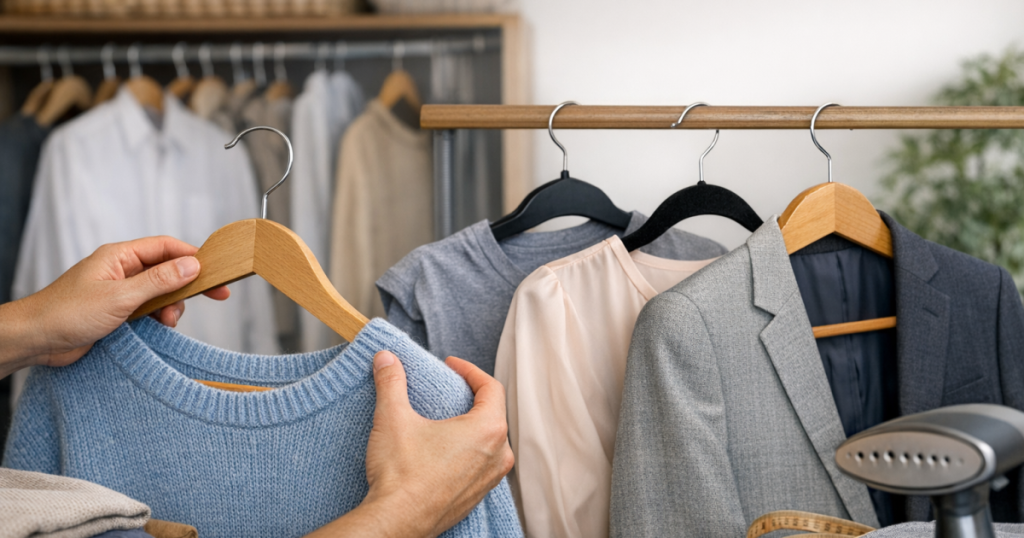
- Wide-shouldered suit hangers suit jackets, blazers and coats because they support the garment’s structure rather than letting it collapse.
- Padded hangers can help delicate blouses and vintage-style pieces, but bulky padding can stretch small shoulders if the hanger is too wide.
Step 3: match the hanger to the fabric
Fabric behaviour should guide the purchase. Cotton poplin and Oxford shirts can usually cope with a firmer hanger. Viscose, modal, bamboo jersey, fine merino and cashmere are more likely to stretch or form pressure marks. Satin and silky polyester can slide off smooth hangers, so grip matters, but rough clips or unfinished edges can snag the surface.
For soft tops, look for a hanger with rounded ends and a gentle slope. The slope should mimic the fall of the shoulder rather than holding the garment out in a rigid triangle. For jackets, the opposite is often true: a broader, shaped hanger keeps the shoulder line from flattening or sagging.
For strappy dresses or camisoles, choose hangers with proper strap notches or a grippy surface. Do not hang heavy dresses from thin straps for long periods, as the straps can stretch while the body of the garment pulls downwards.
Step 4: decide when not to hang at all
Some garments are better folded, however good the hanger is. Heavy wool jumpers, chunky cardigans, ribbed knits and wet or freshly washed knitwear can distort under their own weight. Hanging them may create both shoulder bumps and lengthwise stretching.
For knitwear, fold along natural seams and avoid stacking so high that the bottom items are crushed. If a jumper is damp, dry it flat first and only store it once fully dry. The method in how to dry knitwear flat without stretching it is a safer choice than hanging a wet jumper from a rail.
If rail space is limited, do not solve the problem by using ultra-thin hangers for everything. Slim hangers are fine for light garments, but heavy or stretchy pieces need either better support or folded storage.
Step 5: test before replacing every hanger
Before buying a full matching set, test one or two hanger styles on your most troublesome garments. Leave the item hanging for a day, then check the shoulder line in natural light. If you can feel a point where the hanger ended, the shape is not spreading the weight well enough.
Also check how easily the garment comes off the hanger. Velvet hangers can grip well, but if you have to tug a delicate blouse to remove it, the friction may be too much for that fabric. Smooth wood or plastic may be better for garments you handle daily, while grippy hangers are useful for slippery occasionwear.
For real-world comparison, look at the differences between MAWA Silhouette Light Hangers, Amazon Basics Slim Velvet Non-Slip Suit Clothes Hangers and an IKEA BUMERANG wooden hanger. Rather than treating any one style as universally better, compare the width, end shape, surface and suitability for the clothes you actually hang.
Checks to make in the shop or online
- Look for smooth, rounded shoulder ends with no hard ridge or sharp moulding seam.
- Check whether the hanger width suits your garments, not just your wardrobe rail.
- Choose a non-slip surface only where the fabric needs it.
- Avoid heavy hangers on weak rails or overfilled wardrobes, as crowding can crease shoulders too.
- Use clips only for garments designed to be clipped, and check that clip pads are smooth.
- For jackets, favour shaped shoulders over completely flat economy hangers.
- For delicate tops, avoid unfinished wood, exposed wire and narrow plastic tips.
Common mistakes that cause shoulder marks
The most common mistake is hanging damp clothing. Warm, wet fibres reshape easily, so even a decent hanger can leave a mark if the garment is not dry. Another is cramming too many items onto the rail. When clothes are pressed together, sleeves and shoulders fold around neighbouring hangers and set into odd shapes.
It is also worth checking lint and surface debris on grippy hangers. Velvet-style hangers can collect fibres, which may transfer to dark tops or make delicate fabrics cling awkwardly. If that is a regular issue in your wardrobe, the comparison of reusable velvet lint brushes and sticky rollers may help you choose a simple maintenance tool.
Helpful questions
Are velvet hangers good for preventing shoulder bumps?
They can be, but only if the hanger is the right width and has rounded ends. Velvet grip stops slipping, but it does not fix a hanger that is too narrow or sharply shaped.
Should jumpers be kept on hangers?
Light, stable knits may tolerate short-term hanging on a broad, rounded hanger. Heavy jumpers, cashmere, chunky wool and ribbed knits are usually better folded to prevent stretching and shoulder peaks.
Do padded hangers stop bumps on delicate blouses?
Often, yes, because they soften pressure at the shoulder. They still need to match the garment width, and very bulky padding can distort small or narrow-shouldered tops.
Can shoulder bumps be removed once they appear?
Many minor bumps relax with light steaming or by dampening the area and letting it dry flat. Avoid pulling the fabric aggressively, as that can stretch the shoulder further.
Is one hanger style enough for a whole wardrobe?
Usually not. A mixed wardrobe benefits from at least two or three hanger types: slim rounded hangers for shirts, grippy hangers for slippery pieces, and shaped hangers for jackets and coats.
In brief
The best hanger is the one that supports the garment at the shoulder seam without forcing the fabric into a point. Start with width, then check shoulder-end shape, surface grip and fabric weight. Fold heavy knitwear, use shaped hangers for structured outerwear, and test a small number of hangers before replacing a full rail.