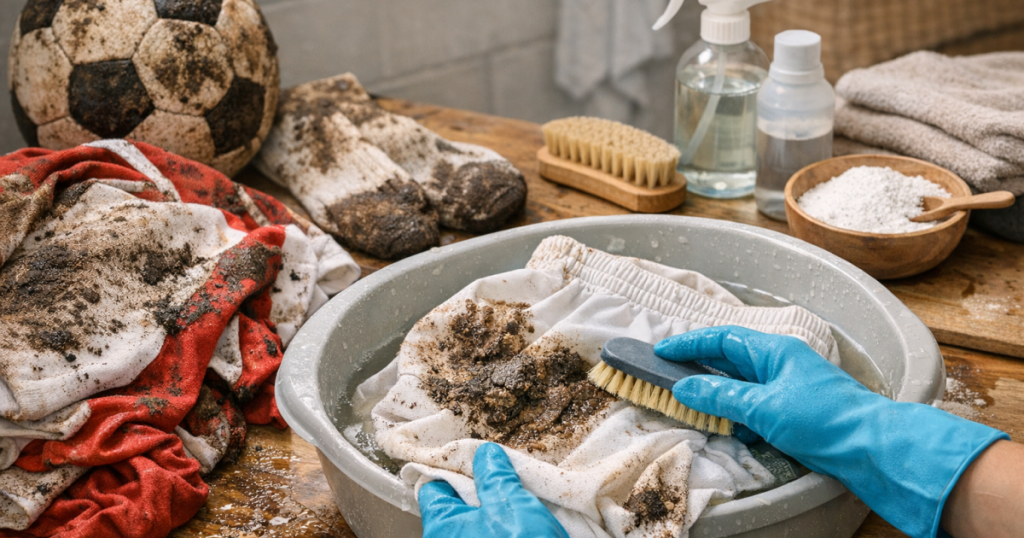
A wet Sunday match can leave shirts, shorts and socks coated in grit, clay and grass residue. The safest way to remove mud from football kits is to let the soil dry first, lift away loose particles, then wash cool enough to avoid fixing protein and mineral stains into synthetic fibres.
The mistake that ruins most muddy kits is rushing them straight into a hot wash. Mud needs a staged approach: dry, loosen, rinse, pre-treat, then wash according to the care label.
At a glance
- Let thick mud dry before handling the kit, unless the garment is already sitting in dirty water.
- Shake or gently brush off dry soil before wetting the fabric.
- Rinse from the back of the stain with cold water to push mud out, not deeper in.
- Use a small amount of liquid detergent on stubborn patches before washing.
- Avoid hot water, tumble drying and ironing until the marks have fully gone.
Why mud sets into football kit fabric
Mud is not one simple stain. It can contain clay, grit, organic matter, grass residue and tiny mineral particles that lodge between yarns. On many football kits, the fabric is a smooth synthetic knit designed to move moisture away from the skin. That helps on the pitch, but it also means dirt can spread across the surface and collect around seams, printed areas and textured sock fibres.
Heat is the main enemy. A hot wash can make some organic residues harder to shift, and a tumble dryer can bake remaining marks into pale shirts and white socks. Strong scrubbing is another problem, particularly on printed club badges, sponsor logos, numbers and delicate mesh panels.
Once you understand the order of treatment, it is much easier to remove mud from football kits without turning a washable mess into a permanent grey-brown shadow.
Step 1: Separate the kit before it reaches the laundry basket
Do not bundle muddy kit with towels, bedding or school shirts. Loose grit can transfer, and wet mud can mark pale cotton or bedding before you have even started washing.
- Put heavily soiled boots and shin pads aside before carrying the kit indoors.
- Keep muddy socks separate from shirts if they are caked with soil.
- Open out shorts and shirts so damp areas can air rather than sour in a bag.
- Check pockets for tape, tissues, wrappers or grass clumps.
If the kit has been left in a kit bag overnight, deal with odour and damp first by airing it briefly. Do not leave wet synthetic sportswear sitting for days, as odour can become harder to remove even after the mud has gone.
Step 2: Let the mud dry, then loosen it gently
For thick pitch mud, drying first usually gives the cleanest result. Wet mud smears when rubbed; dry mud cracks and releases. Hang or lay the garments somewhere ventilated until the surface soil is dry enough to flake away.
Once dry, take the kit outdoors or over a bin and shake it firmly. Use your fingers or a soft laundry brush to lift dried patches. Work slowly around seams, elastic waistbands and sock cuffs where dirt collects.
Avoid wire brushes, stiff scrubbing brushes and aggressive rubbing on printed shirts. If you are dealing with cotton training tops as well as polyester match shirts, it is worth understanding how brushing pressure affects yarns; our guide to whether stain removal brushes damage cotton shirt fibres explains why gentler tools are usually safer.
Step 3: Rinse from the reverse side with cold water
After removing loose soil, turn the stained area inside out and rinse from the back of the fabric under cold running water. This helps push particles out along the route they entered. Rinsing from the front can drive fine clay deeper into the weave or knit.
For socks, stretch the fabric slightly under the tap so water reaches the ribbed areas. For shorts and shirts, concentrate on hems, knees, elbows and lower back panels. Keep the pressure moderate: enough to move soil, not so much that it distorts lightweight mesh.
Do not use hot water at this stage. Cold water is safer for mixed stains because mud from a football pitch may include grass and organic residue as well as soil.
Step 4: Pre-treat the remaining marks
Once the worst dirt has rinsed away, apply a small amount of liquid laundry detergent directly to the remaining muddy areas. Massage it in with your fingertips or a soft cloth, working from the outside of the stain towards the centre to avoid spreading it.
Leave the detergent to sit for around 10 to 15 minutes, but do not let it dry hard on the fabric. For white socks with grey clay staining, repeat the cold rinse and pre-treatment before washing rather than reaching immediately for higher heat.
Be careful with stain removers on printed kit. Always check the care label and test on an inside seam if the garment has bright colours, heat-applied numbers or sponsor prints. Oxygen-based products can be useful on washable whites, but they are not suitable for every fabric, finish or colour.
Step 5: Wash on a suitable programme
Wash football kits with similar colours and fabric types. A sportswear, synthetics or easy-care cycle is often more appropriate than a heavy cotton wash, but the care label should lead the decision. Many kits wash well at 30°C or 40°C, depending on the label and soil level.
- Use enough detergent for the load and local water hardness, but avoid overloading the machine.
- Do not add fabric conditioner to performance sportswear if the care label advises against it, as it can affect moisture-handling finishes.
- Close zips and fasten hook-and-loop strips on training layers to reduce snagging.
- Wash muddy socks inside a mesh laundry bag if they tend to disappear or roughen other items.
If the kit still looks marked after washing, do not tumble dry it. Repeat the rinse and pre-treatment while the fabric is still damp. Drying heat is one of the quickest ways to make a faint mud shadow more stubborn.
Step 6: Dry the kit without shrinking or setting marks
Air drying is usually the safest option for football shirts, shorts and socks. Reshape garments while damp, hang shirts on a hanger or drying rail, and keep printed areas away from direct radiator heat. Radiators can create hot spots that may affect logos, numbers and elastic fibres.
For indoor drying, airflow matters more than simply adding heat. Open a window briefly where practical, use an extractor fan if drying near a utility space, and leave gaps between garments on the airer. The advice in how to ventilate a room when drying laundry indoors is especially useful during wet UK weeks when kits need turning around quickly.
If you need a school PE kit or club strip ready for the next morning, prioritise spin efficiency, spacing and airflow rather than a hotter wash. Similar principles apply to uniforms; the guide to drying school uniforms overnight without shrinking them gives a helpful routine for time-pressed households.
What to do with different types of football kit stains
Clay-heavy mud on white socks
Let the mud dry fully, brush out as much powdery soil as possible, then rinse from the inside. White football socks often hold dirt in the ribbed knit, so a second pre-treatment is normal. Avoid drying until the socks look clean in natural light.
Grass and mud mixed together
Cold rinse first, then use liquid detergent as a pre-treatment. Grass marks can cling to knees and elbows, particularly on goalkeeper kit. Do not use hot water at the start, as mixed stains respond better to a cooler staged treatment.
Mud on printed shirts
Turn the shirt inside out, rinse from the reverse and keep rubbing to a minimum. Avoid soaking for long periods if the shirt has heat-applied lettering or numbers. Wash inside out and air dry away from direct heat.
Old mud stains from a forgotten kit bag
Shake off dry soil, rinse thoroughly and pre-treat before washing. If the kit smells musty, wash promptly after pre-treatment and dry with good airflow. Do not mask odour with extra fabric conditioner; trapped damp and detergent residue can make sportswear smell worse over time.
Common mistakes that make mud stains worse
- Putting muddy kit straight into a hot wash: heat can set remaining marks before the soil has been lifted.
- Overloading the machine: muddy items need room for water and detergent to move through the fabric.
- Scrubbing printed areas: hard rubbing can crack or dull logos, numbers and sponsor prints.
- Using too much detergent: residue can cling to synthetic sportswear and hold odour.
- Tumble drying too soon: always check the kit in daylight before adding heat.
Things readers ask
Should I wash muddy football kits straight away?
Not if they are caked in thick mud. Let the mud dry enough to brush off first, then rinse and pre-treat. If the kit is soaked in dirty water, drain and rinse it sooner so it does not sit damp.
Can I soak a football shirt overnight?
Short soaking can help some washable fabrics, but overnight soaking is risky for printed shirts, bright colours and heat-applied numbers. Check the care label and keep soak times conservative.
Is 40°C too hot for muddy kits?
It depends on the care label. Many kits tolerate 40°C, but cold rinsing and pre-treatment should happen first. If stains remain after washing, repeat treatment before drying.
Can I use bleach on white football socks?
Avoid chlorine bleach unless the care label clearly allows it. It can weaken fibres and affect elastane. For washable white socks, an appropriate oxygen-based laundry product may be safer, but always follow the garment and product instructions.
Why do football kits still smell after the mud has gone?
Sweat, damp storage and detergent residue can leave odour behind. Wash soon after wearing, avoid overloading the machine, skip excess fabric conditioner and dry with plenty of airflow.
Main lessons
Muddy football kits clean up best when you treat soil as something to lift out gradually, not blast away with heat. Dry the mud, brush gently, rinse from the reverse, pre-treat the remaining marks and wash on a care-label-safe cycle. The final check is simple: if you can still see a stain, keep the kit away from the tumble dryer until the mark has gone.