Family ironing quickly exposes the limits of a basic steam iron: school shirts, workwear, bedding and PE kit can turn into a long evening job. The question is whether steam generator irons genuinely cut that workload, or whether they simply add another bulky appliance to store.
For many UK households, the answer depends less on the headline steam claims and more on the weekly pile: how much cotton you press, whether you iron bedding, and whether you have somewhere sensible to keep the base unit.
The short answer for busy households
A steam generator model is worth considering if you regularly iron large loads, several cotton shirts at once, school uniforms, bed linen, table linen or heavier garments that need more steam than a standard iron can comfortably deliver.
It is less convincing if you only touch up the odd T-shirt, avoid ironing bedding, rely mainly on crease-resistant synthetics, or have limited storage in a flat or small utility space. In those cases, a good traditional steam iron or a garment steamer may feel easier to live with.
- Most likely to help: weekly family batches, cotton shirts, pillowcases, duvet covers, uniforms, linen blends and stubborn creases.
- Less useful for: occasional ironing, delicate-only wardrobes, tiny laundry spaces and quick one-garment refreshes.
- Main trade-off: faster pressing and more steam, but a larger appliance to store, fill, descale and set up.
- Often overlooked: your ironing board matters. A heavy base unit on a flimsy board can make the whole setup awkward.
How a generator model differs from a normal steam iron
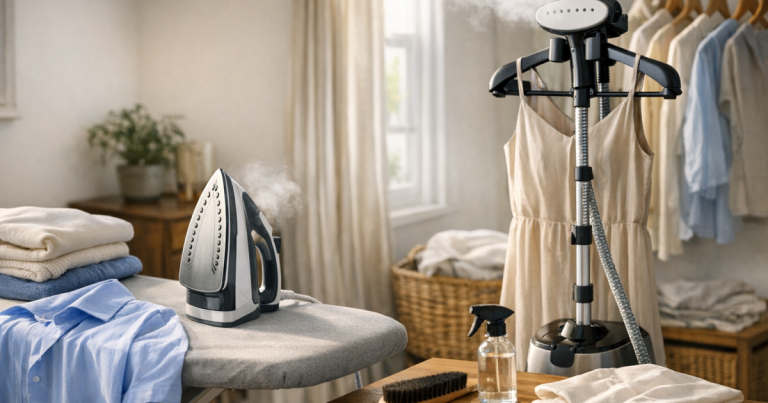
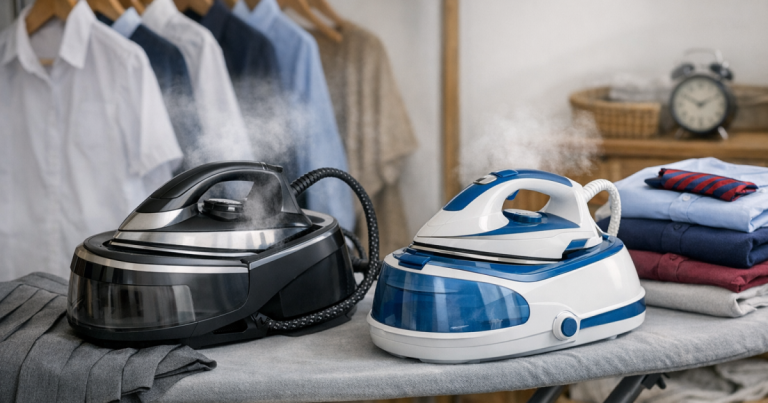
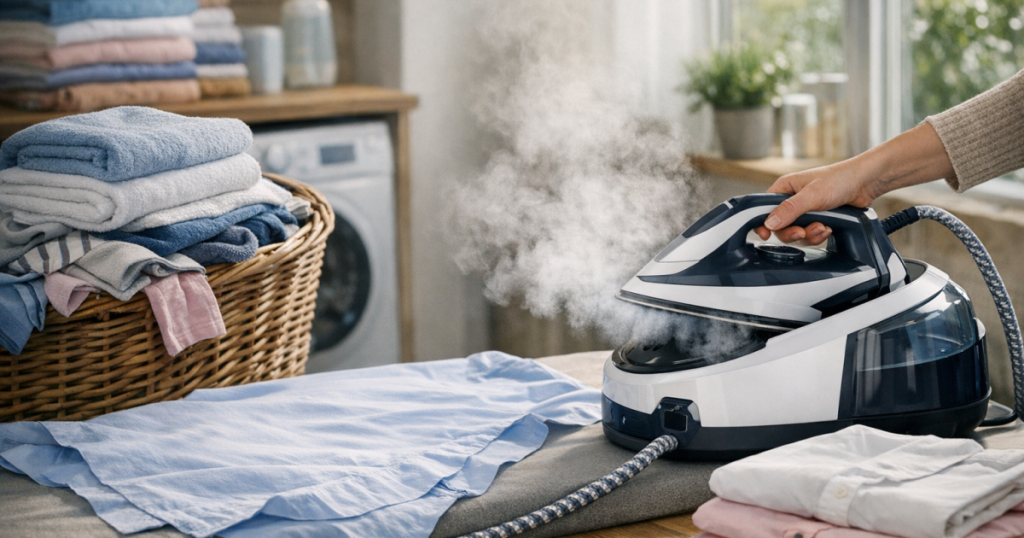
A standard steam iron holds water in the iron itself. A generator setup separates the water tank into a base unit, feeding steam to the hand-held iron through a hose. That design usually gives you a larger water capacity and a steadier supply of steam for longer sessions.
The practical difference is not just power. It is rhythm. With a basic iron, you may refill more often, wait for steam to recover, or repeatedly go over the same cotton shirt panel. With a generator unit, the aim is to move through a stack with fewer pauses, using steam to relax fibres before the soleplate smooths them.
Product pages can be full of numbers, so it helps to understand what wattage, steam output and tank size actually mean before treating a large figure as proof that a machine will suit your laundry routine.
Where steam generator irons earn their keep
The strongest case is a household that irons in batches. If Sunday evening means five school shirts, work shirts, cotton trousers, pillowcases and the occasional duvet cover, the larger tank and stronger steam delivery can make the job feel less stop-start.
School uniforms and work shirts
Cotton-rich shirts, polo collars, pleated skirts and uniform trousers often need defined edges and a smooth finish. A generator iron can help because the steam reaches into creased areas more readily, particularly around collars, cuffs and seams. You still need careful handling: tug seams straight, smooth the fabric by hand first, and avoid pressing over badges or heat-sensitive decoration unless the care label allows it.
Bedding and household linen
If you iron pillowcases, duvet covers or tablecloths, a generator setup can be a genuine time-saver. Large flat items reward continuous steam because you can fold and press sections without constantly refilling. The trade-off is physical space: you need room to park the base safely and move the fabric without dragging it across the floor.
Heavier cotton, linen and denim
Thicker fabrics often hold creases after air drying, especially in winter when laundry dries more slowly indoors. Steam can relax those fibres more effectively than dry heat alone. For linen, press while slightly damp where the care label allows, and use a pressing cloth on darker colours to reduce shine.
When it is probably too much appliance
A generator iron can be impressive and still be wrong for your home. If your ironing pile is usually three garments, the setup time can feel out of proportion. Filling the tank, waiting for heat-up, making space for the base, then emptying or storing it afterwards may cancel out the time saved on the fabric itself.
It may also be a poor fit if you live with limited storage. These units are bulkier than a standard iron, and many people underestimate the space needed for the base, hose and cable. Before buying, check where it will live when cold, where it will sit during use, and whether your board has a heat-resistant area large enough for the base unit.
Delicate-heavy wardrobes are another reason to pause. Silk, embellished garments, some viscose, acetate blends and heat-sensitive synthetics need lower heat, gentler steam or steaming from a distance. A powerful unit is not automatically better for delicate fabric care; control matters more than force.
Check your ironing setup before blaming the iron
A steam generator model works best as part of a stable ironing station. A wobbly board, thin cover or cramped corner can make a powerful iron feel clumsy rather than efficient.
- Board stability: the board should feel steady when the base unit is in place and when you press along the far edge.
- Resting space: check whether the base sits securely on the board’s tray or needs a separate heat-safe surface nearby.
- Cover quality: a flat, well-padded cover helps steam pass evenly and reduces imprint marks from the board mesh.
- Socket position: the cable and hose should not cross walkways or pull across the board while you work.
- Ventilation: heavy steam can add moisture to the room, so open a window or avoid ironing in a cold, unventilated space.
If you are upgrading the whole ironing area, not just the appliance, a stable full-size board can change the ironing setup as much as the iron itself.
Fabric-aware steps for using one well
The best results come from sorting the pile rather than attacking it in random order. Family laundry usually contains a mix of easy-care synthetics, cotton uniforms, dark garments, bedding and delicates, and they do not all want the same treatment.
1. Read the care label first
Check the ironing symbol and fibre content. If a garment says cool iron only, do not treat it like cotton bedding. For blended fabrics, follow the most delicate fibre in the blend unless the label gives clearer instructions.
2. Start with lower-temperature items
Begin with synthetics and delicate blends, then move towards cotton and linen. This reduces the risk of accidentally pressing a heat-sensitive garment with a soleplate that is too hot from a previous item.
3. Use steam where it helps, not everywhere
Steam is useful for cotton, linen and set-in creases, but it is not a cure-all. Some fabrics respond better to a light mist, a pressing cloth or hanging after washing. Avoid blasting steam into structured areas such as suit shoulders, glued hems or delicate embellishments.
4. Press, do not scrub
Let steam and heat do the work. Repeatedly rubbing the soleplate back and forth can distort knits, polish dark fabric or push creases into seams. For collars and cuffs, press in short sections and keep edges aligned.
5. Let garments cool before storing
Hang shirts and uniforms for a few minutes before putting them into a wardrobe. Warm, slightly damp fabric can crease again if it is packed tightly straight away.
Maintenance and running costs to think about
Hard water is common in many parts of England, and limescale can affect steam performance over time. Follow the manufacturer’s instructions on tap water, filtered water, cartridges and descaling. Do not assume distilled water is always recommended; some appliances are designed around ordinary tap water and specific anti-scale systems.
Running cost is also part of the decision, even without quoting a single figure. Longer ironing sessions use electricity, and a powerful appliance used carelessly can waste energy. The practical way to reduce waste is to iron in batches, spin laundry properly before drying, fold items neatly before they become deeply creased, and avoid ironing garments that will smooth out naturally when hung.
For real-world comparison, models such as the Tefal Pro Express Ultimate Steam Generator Iron, Philips PerfectCare 7000 Series Steam Generator Iron and Morphy Richards Power Steam Elite Steam Generator Iron show the kind of format you will see in UK shops: a separate tank, hose-connected iron and features that vary by model. Check the current product details carefully rather than assuming every generator unit has the same controls, tank design or descaling system.
Main points
- Buy one for volume, not novelty. The more shirts, uniforms and bedding you press, the stronger the case becomes.
- Storage and board stability matter. A bulky base unit needs a safe place during use and after cooling.
- Fabric control is essential. More steam helps cotton and linen, but it is not automatically suitable for delicate garments.
- Maintenance is part of ownership. Check descaling, water guidance and filter requirements before committing.
- If your laundry routine is mostly quick touch-ups, a standard steam iron or steamer may be more convenient.
Helpful questions
Is a steam generator iron better than a clothes steamer for family laundry?
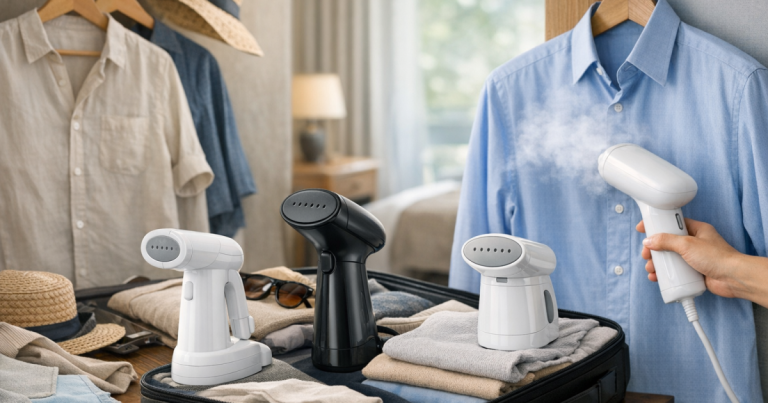
For crisp shirts, uniforms and bedding, yes, because the soleplate gives pressure and structure. For a single creased dress, jacket or packed garment, a travel steamer is still the easier tool.
Will it make ironing completely effortless?
No. It can reduce repeated passes and refilling, but you still need to sort fabrics, position seams properly and use the right heat or steam setting for the garment.
Can I use one on wool jumpers?
Usually, avoid direct heavy pressing on wool knitwear. Use gentle steam from above, a pressing cloth, or follow the care label. Pressing too firmly can flatten the texture or leave shine.
Do I need a special ironing board?
Not always, but you need a sturdy board with enough room for the base unit or a safe nearby surface. A narrow, lightweight board can make the appliance frustrating to use.
Should I empty the tank after every use?
Follow the appliance manual. Some tanks are designed for easy emptying, while others have specific storage and anti-scale instructions. The safest habit is to let the unit cool fully before storing it.
Final thoughts
For a busy family household that irons properly every week, a steam generator iron can be worth the space because it turns a long, stop-start pile into a more continuous job. For occasional ironing, it is often more appliance than you need.
The sensible decision is to judge your laundry basket, not the most impressive feature list. If cotton shirts, uniforms and bedding dominate your pile, the upgrade can make sense. If your routine is mostly quick refreshes and delicate garments, keep things simpler.