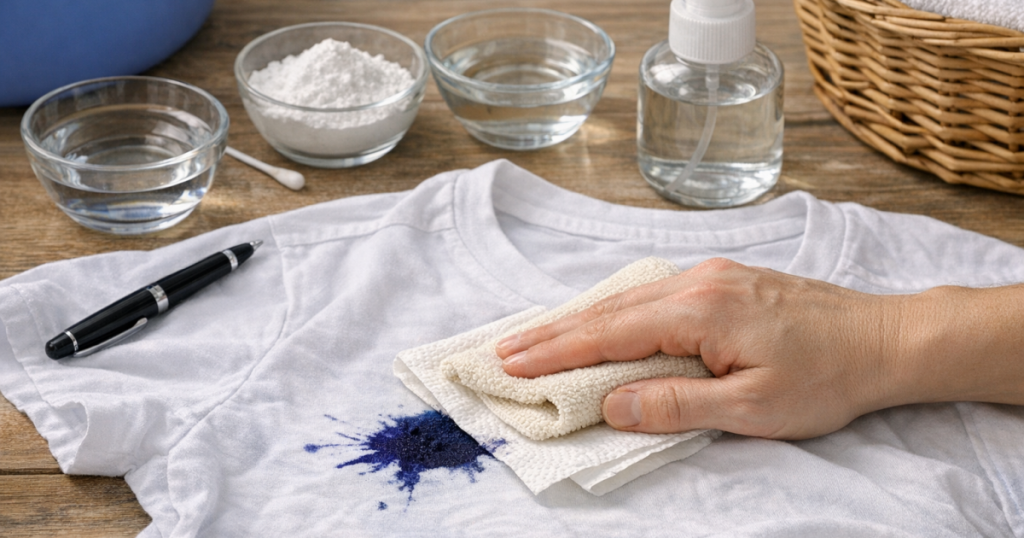
Ink spreads quickly through cotton yarns, but it does not mean the shirt is ruined. The safest way to get ink out of cotton shirts is to lift the dye gradually with blotting, an alcohol-based treatment and a cool wash, not bleach. Work from the back of the stain, keep heat away, and check the mark before drying.
What to know first
Cotton is stronger than many delicate fabrics, but ink behaves differently from mud, food or sweat. It can contain dyes, solvents, pigments and resins that grab onto the fibres. Chlorine bleach is not the best answer: it can weaken cotton, turn some whites yellowish, damage stitching and fail to remove the ink evenly.
The aim is to transfer as much ink as possible out of the shirt before washing. Rubbing hard usually drives the colour deeper and creates a larger cloudy patch. Heat from a tumble dryer, iron or hot wash can make the mark far more difficult to shift.
- Fresh ballpoint ink: usually responds best to blotting and alcohol-based treatment.
- Water-based ink: often lifts with cool water, detergent and patience.
- Gel, permanent marker or printer ink: may need repeated treatment or a specialist ink remover.
- Coloured cotton: needs a colourfastness test before any solvent goes near the visible area.
Before you touch the stain
Put the shirt on a clean towel and check the care label. Most everyday cotton shirts can be washed, but trims, contrast stitching, printed areas and buttons can react differently to stain treatments.
Test your chosen treatment on an inside seam or hidden hem. Dab a tiny amount on, wait a few minutes, then press with a white cloth. If colour transfers from the shirt fabric, do not use that treatment on the visible stain. For coloured shirts that might run in the wash, it is worth reading our guide to choosing colour catcher sheets for mixed washes before laundering the garment with anything else.
Gather a few simple items before starting: white kitchen roll or old white towels, clean white cloths, cool water, liquid laundry detergent, and either isopropyl alcohol or surgical spirit for suitable cotton fabrics. Keep alcohol-based products away from flames and use them in a well-ventilated room.
Step-by-step: removing fresh ink from a cotton shirt
1. Blot, do not scrub
Place a folded white towel or several sheets of kitchen roll under the stained area. Press the top of the stain gently with another white cloth. Lift and move to a clean part of the cloth each time. The goal is to remove loose ink without spreading it into a larger ring.
2. Work from the reverse side
Turn the shirt inside out so you can treat the back of the stained fabric. This helps push ink out the way it entered rather than forcing it further through the cotton. Keep absorbent paper underneath and replace it as soon as it starts picking up colour.
3. Dab with alcohol, slowly
Moisten a white cloth or cotton pad with a small amount of isopropyl alcohol or surgical spirit. Dab around the outer edge of the stain first, then move towards the centre. Do not pour alcohol directly over the shirt, as this can flood the dye into a halo. Keep changing the cloth and the towel underneath so lifted ink is not pressed back into the cotton.
4. Rinse with cool water
Once the transfer slows, rinse the stained area from the reverse side under cool running water. Avoid hot water at this stage. If the mark is lighter but still visible, repeat the alcohol dabbing and rinsing process before adding detergent.
5. Pre-treat with detergent
Rub a small amount of liquid laundry detergent into the remaining mark with your fingertips. Keep the pressure gentle and work only on the stained area. A mild everyday detergent such as Fairy Non-Bio Laundry Detergent can be useful when you want a straightforward pre-wash treatment without using bleach. Leave it for 10 to 15 minutes, but do not let the treated area dry out completely.
6. Wash cool, then inspect
Wash the shirt on the care-label setting, preferably at 30°C while the stain is still being resolved. Use your normal detergent dose and avoid adding chlorine bleach. When the cycle finishes, inspect the shirt in natural light. If any shadow remains, repeat the treatment before drying.
What to do with dried-in ink
Dried ink takes longer because some of the dye has already bonded with the cotton. Start by placing the stained area face down on white towels and dabbing from the reverse with alcohol, as above. You may need several rounds, with fresh towel underneath each time.
If the mark barely moves, use a specialist ink stain remover and follow the label exactly. Products such as Amodex Ink and Stain Remover or Dr. Beckmann Stain Devils Pen and Ink are designed for ink-type stains, but you should still test them first on coloured cotton or shirts with printed details.
For a broader view of when a stain remover is more useful than a fabric-care tool, our comparison of a clothing brush versus a laundry stain remover is a helpful next step.
Common mistakes that make ink worse
- Using chlorine bleach first: it can remove surrounding colour, weaken cotton and leave the ink stain oddly toned rather than gone.
- Rubbing with a dark towel: dye from the towel can transfer, and the rubbing action spreads the ink.
- Washing before blotting: a full wash can distribute loose ink through the fabric and make the edges less defined.
- Drying too soon: tumble drying or ironing can set the remaining mark.
- Mixing stain chemicals: use one treatment route at a time and rinse thoroughly between attempts.
Special cases: school shirts, work shirts and white cotton
For white cotton school shirts, patience is usually better than bleach. Treat the stain, wash cool, then air-dry. If a faint shadow remains, repeat the process while the shirt is still damp. Do not iron over the mark before you are happy with the result.
For coloured Oxford shirts, test colourfastness carefully and avoid soaking the whole garment in solvent. Keep treatment localised to the stain and use clean absorbent layers underneath.
For cotton work shirts with embroidered logos, keep solvent away from the logo thread unless you have tested it. Embroidery can loosen, bleed or pucker if handled roughly. If the stained shirt is part of a uniform, the steps in our guide to washing embroidered workwear without loosening logos will help you protect the branding after stain treatment.
When to stop trying
If the ink has spread across a large area, bled into interfacing, or sat through a hot dryer, home treatment may only improve it rather than remove it fully. Repeating a gentle process two or three times is reasonable. Scrubbing for a long period, using stronger and stronger chemicals, or bleaching repeatedly can leave the cotton thin, patchy or distorted.
For a valued shirt, stop once the fabric starts to feel rough or the colour begins to lift. At that point, a local dry cleaner may be able to assess the stain before further damage is done, particularly if the shirt is expensive, tailored or part of a formal uniform.
Helpful questions
Can I get ink out of cotton shirts after they have been washed?
Yes, if the shirt has not been tumble dried or ironed. Treat the mark from the reverse with alcohol, rinse cool, pre-treat with detergent and wash again. Heat-set ink is harder to remove.
Is hairspray good for ink stains?
Modern hairspray is unreliable because many formulas contain less alcohol and more styling ingredients. Use isopropyl alcohol, surgical spirit or a proper ink stain remover instead, after testing.
Can I use bleach on a white cotton shirt?
It is better to avoid chlorine bleach for ink. It can weaken cotton, affect stitching and leave uneven discolouration. Blotting, solvent treatment and repeated cool washing are safer first steps.
Will alcohol remove the shirt colour?
It can on some dyed cottons, prints and trims. Always test on an inside seam and press with a white cloth before treating the visible stain.
Should I wash the shirt with other clothes afterwards?
Only once loose ink has stopped transferring. Wash it alone or with similar colours the first time after treatment, especially if the shirt is coloured or heavily stained.
What to remember
Treat ink as a transfer job, not a scrubbing job. Blot first, work from the back, use cool water, avoid heat and keep bleach out of the process. Cotton is durable enough for careful repeated treatment, but the best results come from slow, controlled stain lifting before the shirt goes anywhere near the dryer or iron.