A new detergent can look harmless until it meets a delicate dye, a weak fibre or a decorative trim. The safest way to patch-test washing detergent is to try a tiny, diluted amount on a hidden part of the garment before you commit to washing the whole item.
This matters most with silk, wool, viscose, acetate, lace, embroidery, bright colours and anything marked dry clean only. A good test will not guarantee perfection, but it can reveal obvious colour bleeding, texture change, stiffness, shine or warping before the damage is spread across the garment.
The short version
- Check the care label first; do not use a detergent or washing method the label rules out.
- Test on a hidden seam allowance, hem turn-up, inside facing or spare fabric swatch if supplied.
- Dilute the detergent in cool water rather than applying it neat to the fabric.
- Use a white cloth or cotton bud so any dye transfer is easy to see.
- Let the tested area dry fully before judging the result.
- If you see colour movement, tide marks, stiffness, shine, roughness or distortion, do not wash the whole garment with that detergent.
Before you test: decide whether the fabric is suitable for home washing
A patch test is not a way to override the care label. If the label says dry clean only, the whole garment may rely on construction, interlining, dye or finishing that does not respond well to water. Testing a small area can still tell you how the surface reacts, but it cannot prove that shoulder pads, linings, pleats, fused panels or embellishments will survive a full wash.
Be especially cautious with silk satin, wool tailoring, viscose dresses, beaded occasionwear, dark denim trims, bright reds, deep blues and garments with contrasting panels. Some fibres cope with water but not agitation; others keep their colour but lose body or shape. For silk blouses, hand-washing technique matters as much as detergent choice, so it is worth reading more on washing silk blouses without losing sheen before treating a favourite piece.
What you need for a reliable detergent patch test
Keep the setup simple. You are trying to mimic a gentle wash in miniature, not soak or scrub the fabric into submission.
- A clean white cotton cloth, cotton pad or cotton bud.
- A small bowl of cool water, around 20–30°C.
- A tiny amount of the detergent you plan to use.
- A clean towel for blotting.
- Good daylight or a bright neutral lamp for checking the result.
- Optional: a mesh wash bag for later washing if the fabric passes the test.
Use the same detergent format you plan to use in the real wash: powder, liquid, gel or specialist delicates wash. If you normally use a biological detergent for everyday cottons, do not assume it is right for silk or wool; enzyme-based products can be unsuitable for protein fibres. For sensitive fabrics, the detergent label and the garment care label both matter.
Step 1: choose a hidden test area
Pick somewhere that contains the same outer fabric as the visible garment but will not show if the test leaves a faint mark. Good areas include an inside seam allowance, inside hem, under a collar, inside cuff, inner placket or a facing. Avoid testing only on the lining unless the lining is the part you plan to wash; a polyester lining may behave very differently from a silk or viscose outer.
If the garment came with a small spare fabric swatch, use that first. It is the safest option because you can wet, blot and dry it without affecting the finished garment.
Step 2: dilute the detergent properly
Do not dab concentrated detergent straight onto delicate fabric unless the product label specifically tells you to do so for that fibre. Concentrated detergent can create pale spots, stiffness, residue marks or localised colour loss.
Instead, mix a very small amount of detergent into cool water. The solution should feel like lightly soapy wash water, not a stain-treatment paste. If you are testing powder, make sure it has dissolved fully before it touches the cloth; undissolved granules can sit on the surface and give a harsher test than the garment would receive in a careful wash.
Step 3: apply gently and watch for immediate dye movement
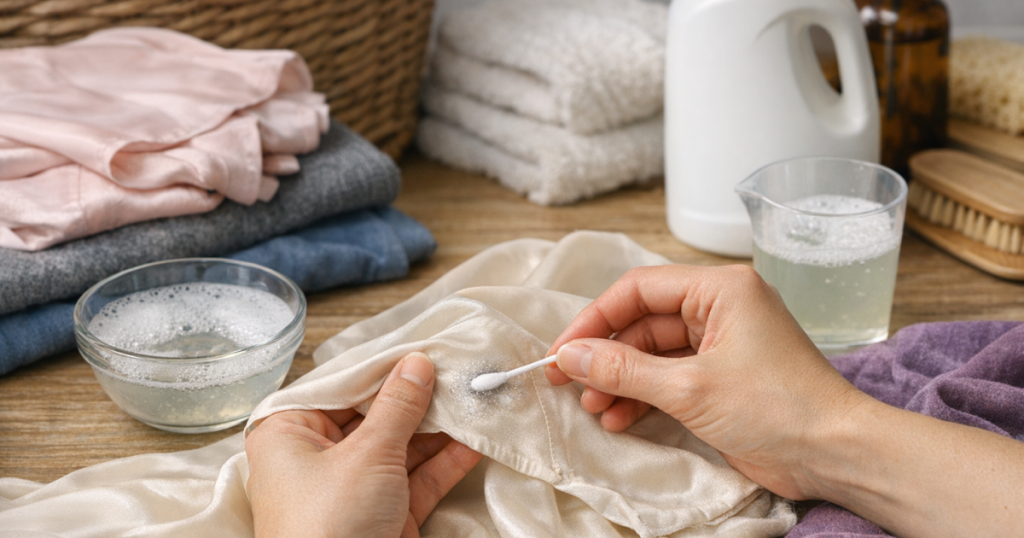
Dip the white cloth or cotton bud into the diluted detergent solution, then press it onto the hidden test area. Use a light dabbing motion. Do not rub, twist or scrub, as friction can damage silk, viscose and wool even when the detergent itself is not the problem.
Check the white cloth straight away. If colour transfers to it, the dye is not stable enough for that detergent and water combination. A tiny hint of dye on the cloth is still a warning sign, particularly on garments with deep colour, printed areas or contrast trims.
Step 4: blot, rinse the small area and let it dry
After a few minutes, blot the area with a clean damp cloth to remove detergent residue, then blot again with a dry towel. Keep the movement gentle and controlled. The aim is to see how the fabric behaves when wetted, cleaned and dried, not just how it looks while damp.
Leave the area to dry fully at room temperature. Do not judge the test while the fabric is still wet, because many materials temporarily darken or stiffen with moisture. Avoid using direct heat from a radiator, hairdryer or iron to speed this up; heat can set distortion, affect sheen or create a misleading result.
Step 5: check colour, texture, shape and finish
Once dry, inspect the tested area beside an untreated section of the same fabric. Look in daylight if possible, and tilt the fabric so you can see changes in sheen.
- Colour: check for fading, bleeding, patchiness, water rings or a lighter halo.
- Texture: feel for roughness, stiffness, limpness, tackiness or residue.
- Shape: look for puckering, rippling, shrinkage or stretched fibres.
- Surface finish: check silk, satin and viscose for dull patches or unwanted shine.
- Trims: inspect embroidery, lace, beads, sequins and printed motifs separately if they were touched by the solution.
If everything looks and feels unchanged, the detergent has passed a basic fabric reaction check. You should still wash the garment gently, using the care label temperature, low agitation and a suitable drying method. For bras, camisoles, lace panels and fine knits, a protective bag can reduce snagging; see the guide to choosing mesh wash bags for delicates if you are unsure which style is appropriate.
How to read the result
A pass means the small test area did not show obvious damage after drying. It does not mean the whole garment can tolerate a normal mixed wash, a hot programme, a fast spin or tumble drying. Delicate fabrics can still distort when soaked for too long, overloaded in the drum or dried hanging from one point.
A fail means you should stop and change the plan. That may mean using a different detergent, washing by hand in cooler water, avoiding water altogether, or taking the garment to a reputable dry cleaner. Do not try to average out the risk by using less detergent in a full wash if the patch has already shown dye transfer or texture change.
Fabric-specific signs to take seriously
Silk
Silk can lose sheen, develop water marks or feel papery after unsuitable detergent. A detergent that is too alkaline or too harsh may not show dramatic colour loss immediately, but a dull patch after drying is a clear warning.
Viscose
Viscose is prone to swelling, creasing, shrinking and warping when wet. A patch that dries wavy, tight or misshapen is a sign to avoid full washing with that method. If the garment is a dress, the weight of wet fabric can add extra distortion; the washing method in washing viscose dresses without shrinking or warping is a useful next step.
Wool and cashmere
Wool and cashmere dislike heat, friction and unsuitable detergents. Watch for felting, fuzziness, roughness or loss of softness. A wool-safe detergent and cool water are usually more appropriate than a general heavy-duty laundry product.
Lace, embroidery and embellished areas
Decorative trims may react differently from the base fabric. Threads can bleed, metallic details can dull, and glued embellishments may loosen when wetted. If trims are central to the garment, test them separately on a hidden section where possible.
Common mistakes that make the test less useful
- Testing with plain water only: water testing is helpful, but it does not show how the detergent itself affects dye or finish.
- Rubbing the fabric: friction can create damage that looks like detergent failure.
- Using too much detergent: a strong solution can cause residue or spotting that would not occur in a properly diluted wash.
- Judging while wet: many fabrics look darker or flatter until completely dry.
- Testing the wrong layer: lining, pocketing and outer fabric can all behave differently.
- Ignoring construction: a fabric swatch may pass while a structured garment still cannot be safely washed.
Questions people ask
Can I test detergent on the inside label area?
Only if the label area includes the same main fabric. A care label stitched into a seam is often attached to lining or seam tape, which may not react like the outer material.
How long should I wait before deciding the test has passed?
Wait until the area is fully dry. For thicker seams, wool or layered fabric, that can take several hours. The final dry texture and shape matter more than the wet appearance.
Should I patch test every time I change detergent?
Yes, for valuable, delicate or uncertain garments. Different detergents can vary in enzymes, optical brighteners, fragrance, pH and residue, all of which may affect sensitive fabrics.
What if the fabric passes but the colour still runs in the wash?
A small test reduces risk but cannot recreate a full wash exactly. Wash delicate colours separately, keep the water cool, minimise agitation and stop if you see dye bleeding.
Is a patch test useful for skin sensitivity?
This test checks fabric reaction, not skin allergy or irritation. If detergent causes skin symptoms, follow the product label advice and seek appropriate health guidance.
Final thoughts
A detergent patch test is a small extra step that can save a delicate garment from permanent damage. It is most useful when you treat it as part of a wider care decision: read the label, respect the fibre, test the hidden area, then wash gently only if the result is clean, stable and unchanged.
When the test result is uncertain, choose the more cautious route. With silk, viscose, wool, embellished garments and sentimental occasion pieces, avoiding damage is usually easier than trying to reverse it afterwards.