Removing grease stains from work trousers is easiest when you keep heat away, lift out excess oil first and give detergent time to break the mark down. The aim is not to scrub harder, but to stop the grease spreading and wash only when the fabric and care label allow it.
Safety note: Workwear contaminated with fuel, solvents, machine oil, chemicals or other hazardous substances should be handled through your employer’s approved laundering process or a qualified workwear laundry to support compliance with UK workplace safety requirements.
The short version
- Blot fresh grease with kitchen paper or a clean cloth; do not rub it across the fabric.
- Keep the trousers away from tumble-dryer heat, radiators and hot irons until the mark has fully gone.
- Pre-treat the stained area with a small amount of liquid laundry detergent or mild washing-up liquid, then leave it to work before washing.
- Wash at the warmest temperature allowed on the care label, commonly 30°C or 40°C for many uniform trousers.
- Check the stain in natural light before drying. Heat can set oily marks and make them much harder to shift.
First, check what the trousers are made from
Work trousers vary a lot. A pair of cotton drill trade trousers can usually tolerate more agitation than stretch office trousers, while polyester-rich uniform trousers may hold onto oily marks but dry quickly. Some workwear also has reflective trim, reinforced panels, water-repellent finishes or company embroidery, all of which can affect what you should use.
Before treating the stain, read the care label and any employer laundering instructions. If the trousers are part of PPE or have high-visibility reflective tape, avoid strong degreasers, bleach and very hot washes unless the garment instructions explicitly allow them. These features are part of the garment’s function, not just decoration.
Step 1: Lift off as much grease as possible
Fresh grease sits on the surface before it starts to migrate deeper into the fibres. Put a piece of kitchen paper, a clean white cloth or an old towel behind the stained area so the oil does not transfer to the other side of the leg. Blot from the outside of the mark towards the centre.
If there is thick grease, scrape the excess away gently with the edge of a spoon or a blunt knife. Avoid using anything sharp, especially on twill, stretch fabrics or trousers with a brushed finish. The goal is to remove the surplus without pushing it further into the weave.
Step 2: Add an absorbent powder for heavy oil
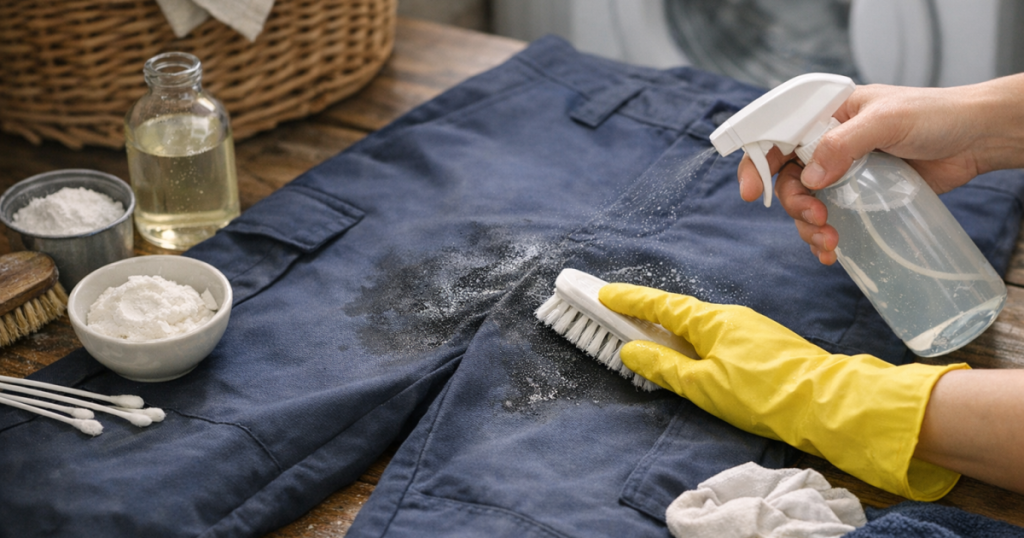
For a wet, shiny or very oily patch, an absorbent powder can help before you add detergent. Sprinkle bicarbonate of soda, cornflour or talcum powder over the mark and leave it for at least 15 to 30 minutes. On a heavier stain, leave it longer if the fabric is stable and dry.
Brush the powder away carefully, then inspect the area. If the powder has clumped or darkened, it has absorbed some of the oil. You may need to repeat this once before moving on to detergent, particularly on cargo trousers, chef trousers, mechanic trousers or warehouse workwear where grease can be heavy.
Step 3: Pre-treat with detergent, not brute force
Apply a small amount of liquid laundry detergent directly to the stain and work it in gently with your fingertips or a soft laundry brush. A mild washing-up liquid can also help with oily food or bike-chain marks, but use only a little and rinse the area before machine washing so excess foam does not build up in the drum.
Leave the pre-treatment to sit for around 10 to 20 minutes, unless the care label or product label gives a different instruction. Do not let detergent dry hard on the fabric. On dark uniform trousers, test a hidden seam first to check for colour change, especially if the trousers are black, navy or charcoal.
If you use a dedicated spot cleaner, choose one that suits the fabric and stain type rather than assuming stronger is better. For a closer look at a gel-style option for everyday laundry, see our Shout Advanced Gel Stain Remover review.
Step 4: Wash at the right temperature
Grease needs detergent action, movement and enough warmth to help lift it, but that does not mean using the hottest wash available. Follow the garment label first. Many work trousers are washed at 30°C or 40°C, while some tougher cotton workwear may allow warmer settings. Stretch fibres, reflective trims and coated finishes are more sensitive.
Wash the trousers with similar colours and avoid overloading the machine. A tightly packed drum reduces water movement, so the detergent cannot circulate properly through the stained area. If the trousers are heavily soiled, wash them separately from lighter household laundry.
For older grease stains from work trousers, a normal quick wash may not be enough. Use a standard-length cottons or synthetics programme that matches the fabric label, then check the stain before deciding whether to repeat the treatment.
Step 5: Inspect before drying
This is the step that makes the biggest difference. Once a greasy mark has been through a hot tumble dryer, placed on a radiator or pressed with a hot iron, it can bond more stubbornly with the fibres. Look at the trouser leg in daylight if possible, because faint oil shadows are easy to miss under warm indoor lighting.
If the mark remains, do not dry the trousers fully. Repeat the pre-treatment and wash again. If you are air drying workwear and want to reduce drying time without leaving heavy moisture in the fabric, our guide to choosing the right spin speed before air drying explains how to balance water removal with fabric creasing.
Common grease stain scenarios
Cooking oil on hospitality trousers
Blot quickly, then pre-treat with liquid detergent. Cooking oils can spread into a pale halo, so treat beyond the visible centre of the stain. Avoid very hot water at the start, as it can make some food soils harder to manage when mixed with other residues.
Bike chain grease on commuting trousers
Chain grease often contains dark particles as well as oil. Scrape off any surface residue first, then blot. Pre-treat gently from the reverse side if the fabric allows it, so you are encouraging the mark out rather than pushing it deeper into the face of the cloth.
Machine oil on trade workwear
Light machine oil can sometimes be treated like other greasy marks, but heavy industrial contamination is different. If the trousers smell strongly of fuel, solvent or chemicals, keep them away from household laundry and follow workplace laundering procedures.
Old oil shadows on office uniform trousers
Older marks often look like a slightly darker patch rather than a clear stain. Re-wet the area, apply liquid detergent, leave it briefly, then wash on the care-label setting. Do not keep increasing the temperature unless the garment label allows it.
What to avoid
- Do not iron over a grease mark. Heat and pressure can make oily residue more persistent.
- Do not use bleach on grease. It is not the right tool for oil and can damage colour, trims and fibres.
- Do not scrub aggressively. Hard scrubbing can raise the fabric surface, fade the area or create a worn patch.
- Do not mix stain products. Use one method at a time and rinse as directed on the product label.
- Do not use workshop degreasers on clothing. Products intended for engines, floors or tools are not automatically safe for garments.
If the trousers are delicate, dark or part of a uniform set
Uniform trousers often need to keep their shape, colour and finish because they are worn repeatedly in customer-facing or professional settings. If the fabric is dark, dab rather than scrub and avoid leaving any pre-treatment on for longer than instructed. If the trousers match a jacket or waistcoat, colour loss on one piece will stand out.
For sensitive skin households, lightly soiled uniforms or garments where fragrance is a concern, it may be useful to understand gentler stain-treatment options. Our Ecover Zero Stain Remover review looks at how a fragrance-free approach fits into everyday laundry routines.
When the stain still will not shift
If the mark remains after two careful attempts, pause before escalating. Repeated hot washes, stiff brushing and strong stain removers can cause more visible damage than the original oil patch. At that point, consider whether the trousers are worth further treatment, whether they are part of employer-issued workwear, and whether a professional cleaner is appropriate.
For washable everyday work trousers, one more controlled pre-treatment may be reasonable. For dry-clean-only trousers, lined uniform trousers or garments with specialist finishes, follow the care label and explain the stain type clearly to the cleaner.
Questions people ask
Can I use washing-up liquid on work trousers?
Yes, a small amount can help with oily marks, especially food grease, but rinse it before machine washing and avoid using it on fabrics where the care label warns against wet treatment.
Should I wash grease-stained trousers in hot water?
Use the warmest temperature allowed on the care label, not the hottest setting on the machine. For many uniform trousers, that will be 30°C or 40°C.
Why is the stain still visible after washing?
Oil can remain as a faint shadow if it was not fully lifted before washing. Treat it again before drying, because heat is what usually makes the mark harder to remove.
Can I tumble dry the trousers after treating the stain?
Only tumble dry once the stain has completely gone and the care label allows it. If you are unsure whether a shadow remains, air dry first and inspect again.
What if the grease is from chemicals or fuel?
Do not put chemically contaminated workwear in a domestic wash. Use your employer’s approved laundering route or a qualified workwear laundry.
Main points
Act quickly, absorb the excess, pre-treat with a suitable detergent and wash according to the care label. The most important rule is to keep heat away until the mark has disappeared. That simple habit protects the fabric, keeps uniform trousers looking presentable and gives you the best chance of removing grease without fading, roughening or misshaping the garment.