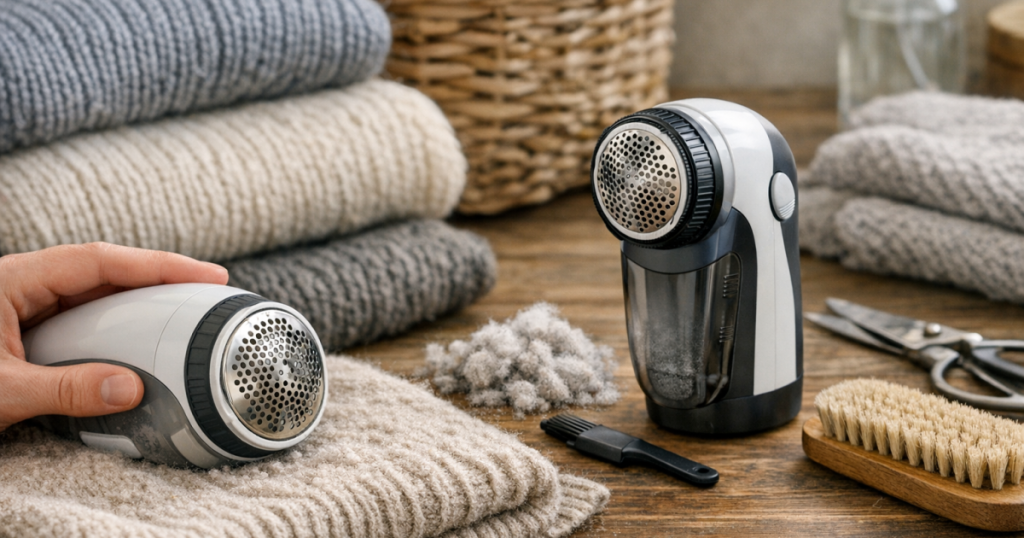
Bobbles can make a good wool jumper look tired long before the garment is worn out. Buying a fabric shaver for knitwear is less about choosing the most aggressive gadget and more about finding a tool that lets you remove pills evenly, gently and with enough control for the fibre in front of you.
The best choice depends on what you own: chunky lambswool, fine merino, synthetic blends, cardigans with seams and buttons, or delicate pieces you only refresh occasionally.
What to know first
A good knitwear shaver should remove pills, not flatten the yarn. Before buying, look for these points:
- An adjustable or well-spaced guard so the blades do not sit too close to raised stitches.
- A cutting head that feels smooth over curves, ribbing and seams.
- Enough control in the handle to work slowly, without pressing into the fabric.
- A lint chamber that is easy to empty, because clogged shavers can drag.
- Replacement blade availability, or at least clear instructions on blade care.
- A power format that suits how often you use it: occasional touch-ups need less kit than regular uniform or knitwear maintenance.
Technique matters as much as the tool. If you want the full method before you start on a favourite jumper, read our guide to removing bobbles from jumpers without thinning the fabric.
Step 1: Match the tool to the knitwear you actually own
Start with your wardrobe, not the shaver. Fine knits need a lighter touch than chunky wool. A close-cutting head may be useful on a dense acrylic blend, but it can be too harsh on a lofty jumper where the surface fibres are part of the look and feel.
For everyday wool blends, a standard electric shaver with a protective foil and a comfortable grip is usually the most convenient option. For cashmere, alpaca, mohair blends or loosely spun wool, choose more cautiously: a shaver with good guard clearance and steady control is preferable to one that feels fast but unforgiving. For very delicate pieces, a manual comb or specialist knitwear stone may be safer than an electric blade, provided it is used gently.
Cashmere deserves particular care because shrinkage, friction and rough handling can all change the garment. If your jumper needs cleaning before de-bobbling, follow a fibre-safe wash routine first; our advice on washing cashmere jumpers without shrinking them explains the handling and drying steps that help protect the fibres.
Step 2: Check the guard and cutting head
The guard is the part that sits between the blades and your jumper. On knitwear, it is one of the most important buying checks. A guard with openings that are too large or a head that catches at the edges can pull loops into the blade area. A smooth, rounded cutting surface is better for moving across sleeves, shoulders and side seams.
Look for:
- Height control or sensible blade spacing: useful when moving between thick jumpers and tighter knitted fabrics.
- A smooth foil or mesh surface: this should glide without snagging loose fibres.
- A head size that suits your garments: large heads cover flat areas quickly, while smaller heads are easier around cuffs, collars, button bands and textured panels.
- Clear instructions: the manual should explain which fabrics to avoid and how to clean the head safely.
A shaver that looks impressive but gives you little control can remove too much surface fibre. The aim is not to make knitwear look new at any cost; it is to tidy pills while keeping the structure and softness of the yarn intact.
Step 3: Choose the right power style for your routine
Fabric shavers are commonly sold as battery-powered, rechargeable or mains-powered tools. None is automatically best for every home, so think about where and how you use it.
- Battery-powered models: handy for occasional touch-ups and storage in a drawer, but check what batteries are required and how access to the battery compartment feels.
- Rechargeable models: convenient if you maintain knitwear regularly, though you should verify charging method, runtime guidance and whether the tool can be used comfortably for a full garment.
- Mains-powered models: useful for longer sessions, but the cable must not pull across the jumper or restrict your working position.
Weight and shape matter more than many buyers expect. A tool that is too bulky can encourage heavy-handed use. A handle that feels secure lets you work with flat, gentle passes rather than short, jabby movements.
Step 4: Make cleaning and lint collection part of the decision
Lint collection is not just a convenience feature. When the chamber fills, loose fibres can clog the cutting area and make the shaver drag or leave uneven results. A transparent chamber helps because you can see when it needs emptying, but the real test is whether it comes off easily and clicks back securely.
Before buying, check how the head opens and whether the cleaning brush is supplied or easy to replace. You should be able to clear lint from the foil, blade area and chamber without forcing small parts. If the shaver is awkward to clean, it is more likely to be used when partially clogged, which is when snagging and patchy shaving become more likely.
Step 5: Look at blades, replacements and build quality
Sharp, clean blades make a fabric shaver work with less pressure. Dull blades can tug at pills rather than cutting them cleanly. Check whether replacement blades are available from the brand or retailer, and whether the product listing clearly explains maintenance. Do not assume every low-cost shaver has easy-to-find spares.
Build quality also shows up in small details: a guard that sits flush, a lint container that does not rattle loose, a switch that is easy to use without accidental changes, and a head that can be removed for cleaning without feeling flimsy. These are practical signs that the tool will be pleasant to use through more than one winter.
Examples worth comparing
Real-world examples can help you understand the range, even if the best option depends on your fabrics and budget. The Steamery Pilo 2 Fabric Shaver is often considered by shoppers who want a design-led rechargeable option for regular knitwear maintenance. The Philips GC026/80 Fabric Shaver is a familiar compact style that many UK buyers compare when they want a straightforward electric de-bobbler. The BEAUTURAL Fabric Shaver and Lint Remover is another recognisable option to check when comparing guard style, head size and cleaning access.
For very delicate or textured knitwear, it is also worth comparing an electric shaver with a manual tool such as the Gleener Ultimate Fuzz Remover. Manual tools are slower, but they can give more tactile control on areas where an electric blade feels too direct. Whichever route you choose, verify fabric suitability, cleaning method and spare-part support rather than relying only on star ratings.
How to test a shaver on a jumper
Once you have bought a shaver, do not start in the centre of the chest. Use this simple check first:
- Lay the jumper flat on a firm, smooth surface so the fabric is supported.
- Choose a hidden area, such as the inside hem or a lower side seam.
- Hold the fabric lightly taut without stretching it out of shape.
- Use the highest guard setting or the lightest contact available.
- Make one slow pass, then stop and inspect the surface in daylight.
- Empty the lint chamber before it becomes packed with fibres.
- Work around seams, cables, embroidery and buttons rather than forcing the head over them.
If the surface looks fuzzy, thin or flattened after one pass, stop. That garment may need a gentler method. Knitwear with long surface fibres, decorative yarns or loose loops can be damaged quickly by repeated shaving.
Prevention still matters
A fabric shaver for knitwear is useful, but it should not be your only defence against bobbles. Pilling is caused by friction, so storage, washing and drying habits make a noticeable difference. Wash jumpers inside out when the care label allows, avoid overloading the machine, and keep rougher garments away from soft knits in the wash basket.
Drying also matters. Excess heat and rubbing can rough up fibres, while slow drying in a cramped space can leave knitwear smelling stale. If you use a heated airer in a UK home where indoor drying is common, choose and use it carefully; our guide to choosing a heated airer that will not overdry knitwear explains what to check.
Common questions
Can a fabric shaver ruin a wool jumper?
Yes, if it is pressed too hard, used on an unsuitable knit, or moved repeatedly over the same area. Wool jumpers need light passes and good fabric support. The safest approach is to test a hidden area and stop as soon as the pills are removed.
Is a bigger cutting head better?
Not always. A bigger head can be quicker on flat panels, but smaller heads are easier around cuffs, ribbing and seams. For knitwear, control is often more useful than speed.
Should I use a shaver before or after washing?
It depends on the garment. If the jumper is dusty, musty or marked, clean it according to the care label first and let it dry fully. Shaving damp knitwear is a bad idea because fibres can stretch, clump or catch.
How often should knitwear be shaved?
Only when needed. Regularly shaving the same areas removes tiny amounts of fibre each time. Treat bobbles as a maintenance issue, not a weekly routine.
What to remember
The right fabric shaver is the one that gives you control over contact, pressure and cleaning. For most UK wardrobes, that means a smooth guarded head, comfortable handling, easy lint removal and clear maintenance support. For delicate fibres, choose caution over speed and consider whether a manual tool is the better match.
Good knitwear care is a chain of small decisions: washing gently, drying well, storing without friction and shaving only when the surface needs tidying. Get those basics right and a fabric shaver becomes a useful finishing tool, not a risky rescue attempt.