Mixed washes are tempting when the basket is full, but one unstable red sock or new navy top can tint a whole load. The right colour catcher sheets give you a useful safety net, provided you choose them for the fabrics, dye risk and wash cycle you actually use.
They are not a licence to ignore care labels or wash every colour together. Think of them as an extra layer of protection for ordinary mixed loads, not a rescue tool for garments that are already likely to bleed heavily.
The short version
- Choose stronger dye-catching protection for new, dark or bright garments, and lighter everyday sheets for already-washed mixed colours.
- Check the pack instructions for how many sheets to use per load, rather than guessing from drum size alone.
- Do not rely on a sheet for hand-dyed items, very new indigo denim, non-colourfast garments or anything marked wash separately.
- For school uniforms, workwear and delicates, match the sheet to the garment care label, detergent choice and wash temperature.
- If the sheet comes out very dark, treat that as a warning: the load contained a garment that may need separate washing next time.
What these sheets can and cannot do
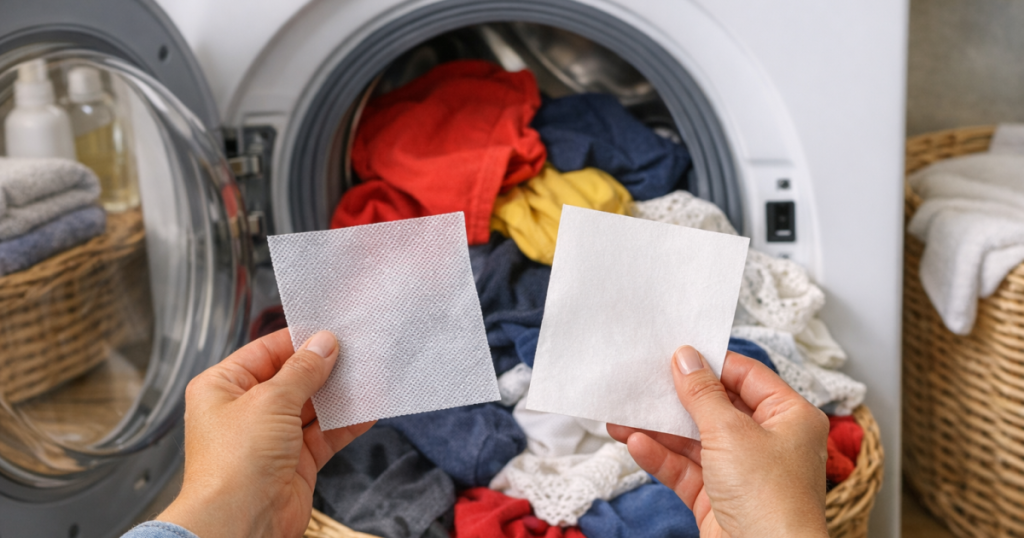
Dye-catching sheets are designed to attract loose dye released into the wash water before it settles on other fabrics. They are most useful when you are washing garments that have already been laundered a few times but may still release small amounts of colour.
Colour catcher sheets cannot stop every dye accident. A brand-new red cotton dress, dark untreated denim or a garment labelled “wash separately” can release more dye than a sheet can sensibly handle. They also cannot reverse colour transfer once it has happened, so the real value is prevention.
The fabric itself matters too. Smooth synthetics may shed loose dye differently from brushed cotton, jersey, towelling or viscose. A sheet may collect visible dye, but it will not protect against shrinkage, stretching, snagging, logo damage or heat-related issues. Keep the garment care label in charge, then use the sheet as a supporting tool.
Match the sheet to the kind of mixed wash
Everyday lights and mid-colours
For routine family washing, such as pale T-shirts, grey sweatshirts, blue shirts and already-washed cotton basics, a standard dye-catching sheet is usually the sensible starting point. Look for packs that state they are suitable for mixed colours and normal machine washing, then follow the dosage instructions for the load.
New brights and darks
New red, green, purple, navy and black garments are higher-risk. Use a stronger or “max protection” style sheet if the pack offers one, but still wash the first few cycles with similar colours. A dye-catching sheet is helpful, but it should not be asked to compensate for a risky load that could have been split.
School uniforms
School shirts, polo tops, sweatshirts and trousers often end up in mixed loads because they are needed again quickly. If you are combining whites, greys and coloured uniform pieces, use a sheet only alongside a suitable detergent and a temperature that matches the labels. For detergent choice, the advice in choosing non-bio detergent for school uniforms is a useful next step.
Delicate dresses and softer fabrics
Viscose, satin blends and lightweight dresses need gentler handling than everyday cotton. A dye-catching sheet may help with colour security, but the wash cycle, water temperature and drying method are more important for shape. If viscose is part of your mixed-load problem, read how to wash viscose dresses without losing their shape before relying on a sheet alone.
What to check on the pack before buying
- Suitable wash type: Check whether the sheet is intended for mixed colours, whites with colours, dark washes or general colour protection.
- Number of sheets per load: Some packs advise more than one sheet for larger, darker or riskier washes. Follow the wording on the box rather than assuming one sheet is enough.
- Temperature guidance: Make sure the sheet suits the temperatures you commonly use, such as 30°C or 40°C cycles for everyday clothing.
- Fabric compatibility: The sheet should fit your actual laundry habits, whether that means cotton uniforms, sportswear, towels, synthetic blends or delicates.
- Fragrance and skin preferences: If your household prefers low-fragrance laundry products, check the packaging carefully rather than assuming all sheets are neutral.
- Disposal guidance: Some sheets are disposable after use. Check the manufacturer’s instructions for disposal and do not flush them.
- Machine use: Confirm that the product is intended for domestic washing machines and follow placement instructions, usually placing the sheet inside the drum with the laundry.
Examples worth comparing
Two familiar options UK shoppers may come across are Colour Catcher Max Protect and Dr. Beckmann Colour Collector Complete Action. Use them as comparison points rather than assuming one pack suits every household. Check the current packaging for sheet count, usage directions, temperature suitability and any claims about whites, colours or darker loads.
For a small flat, shared house or single-person household, pack size and storage may matter more than buying the largest box. For families washing uniforms, towels and casual clothes several times a week, cost per wash and how often you need more than one sheet become more important. Do the simple maths from the pack you are holding: number of sheets, likely sheets per wash, and how many mixed loads you run in a normal week.
How to use them in a mixed wash
- Sort the obvious risks first: Separate brand-new darks, strong reds, indigo denim and anything marked wash separately.
- Check garment labels: Keep delicate, hand-wash, dry-clean-only and low-temperature garments out of unsuitable machine loads.
- Place the sheet in the drum: Put it in with the clothing unless the pack says otherwise. Do not put it in the detergent drawer.
- Use the right detergent dose: Too much detergent can leave residue; too little may not clean properly. Follow the detergent label for water hardness and soil level.
- Choose a sensible cycle: A cooler 30°C or 40°C wash is common for mixed everyday clothing, but the garment label should decide.
- Remove the sheet after washing: Do not leave it tangled in damp clothing. If it is heavily stained with dye, separate the likely culprit next time.
- Dry with care: Colour protection in the wash does not prevent stretching, heat damage or creasing during drying.
When not to rely on a dye-catching sheet
There are times when the safest choice is still to separate the garment. Do not rely on a sheet for newly dyed clothing, hand-dyed fabrics, wax prints, unstable reds, very dark denim, costume pieces, or anything with a care label that clearly says to wash separately or wash with similar colours.
Workwear also needs a little extra thought. Hi-vis garments, reflective trims and printed safety markings can be affected by the wrong temperature, detergent or drying method. A dye-catching sheet may help with loose colour in the drum, but it will not protect reflective strips; use the care steps in washing hi-vis workwear without damaging reflective strips for those items.
Buying checks that make the difference
- If your problem is occasional colour run: Choose a general mixed-wash sheet and keep sorting obvious risks.
- If you often wash darks with mid-colours: Look for a stronger protection option and expect to use more sheets for riskier loads if the pack instructs it.
- If you wash many uniforms: Prioritise reliable everyday use, clear instructions and compatibility with lower-temperature washes.
- If you wash delicates: Choose the gentlest suitable wash cycle first; the sheet is secondary.
- If whites matter most: Avoid washing whites with high-risk colours, even with a sheet. Prevention is safer than hoping the sheet catches everything.
- If you are trying to reduce waste: Compare pack materials, sheet disposal guidance and whether you can reduce mixed-load risk through better sorting instead.
Things readers ask
Can I use more than one sheet in a wash?
Yes, if the product instructions allow it. Larger loads, new darks and strong colours may need more protection, but the pack guidance should decide the number.
Will a sheet let me wash whites with colours?
Only with low-risk, already-washed colours. Do not put important whites in with new reds, dark denim or garments labelled wash separately.
Why did the sheet come out dark grey?
It collected loose dye from the wash water. That is useful information: one or more garments in the load is still releasing colour and may need separate washing.
Do colour-catching sheets replace sorting?
No. They reduce risk in sensible mixed loads, but sorting by colour, fabric type and care label remains the best protection.
Can I reuse a sheet if it still looks pale?
Most are intended for single use. Follow the manufacturer’s instructions and do not reuse unless the pack clearly says it is suitable.
Main points
Choose colour catcher sheets by dye risk, fabric type, wash temperature and how mixed your loads really are. They are most helpful for everyday mixed colours and less reliable for brand-new, dark or unstable garments. If you treat them as a backup rather than a shortcut, they can make busy UK laundry routines easier without putting favourite clothing at unnecessary risk.