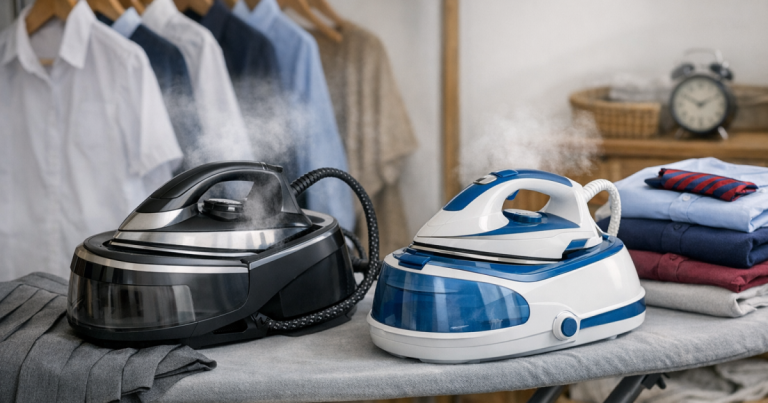
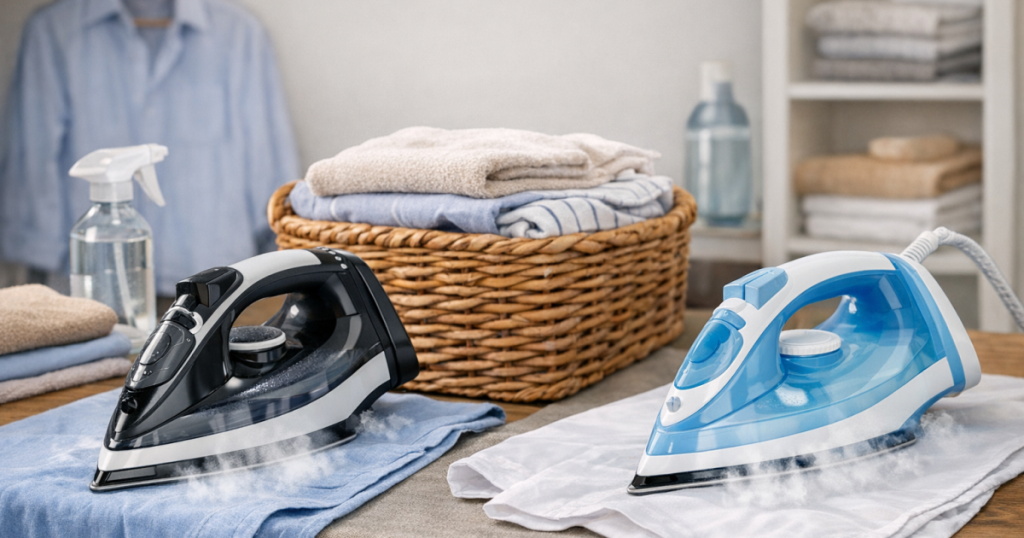
Choosing between two affordable steam irons is less about chasing the biggest feature list and more about matching the iron to your laundry basket. Tefal Express Steam FV2835 vs Philips EasySpeed GC1740/26 is a sensible comparison if you mostly press shirts, school uniform, cotton tops, bedding edges and everyday workwear at home.
Both sit in the familiar corded steam iron category rather than the larger steam generator category, so the real question is workload: how often you iron, how stubborn your creases are, how much storage space you have, and how careful you need to be with mixed fabrics.
The short answer
The Tefal Express Steam FV2835 is the more natural choice if you want a little more crease-fighting headroom for regular family laundry, heavier cottons and repeated ironing sessions, provided the current retailer listing confirms the steam output, tank size and soleplate details you expect.
The Philips EasySpeed GC1740/26 makes more sense if you want a straightforward, low-fuss iron for lighter everyday use: office shirts, cotton T-shirts, simple blouses, pillowcases and occasional touch-ups. It is the kind of iron that suits smaller households, students, spare-room storage or anyone who does not want a bulky setup.
If your clothes are mostly delicate, textured, pleated or wool-rich, neither iron should be treated as a universal answer. Heat, pressure and direct soleplate contact matter as much as steam. For tricky fibres, the safer decision is often a lower heat setting, a pressing cloth, or steam used without dragging the iron hard across the surface.
How the two irons differ in real laundry use
Crease removal and steam headroom
For cotton shirts, chinos, school trousers and bedding, steam helps relax fibres before the hot soleplate smooths them into shape. If one model’s current specification shows stronger continuous steam or a more powerful steam shot, that usually matters most on thick cotton, dry creases and laundry that has sat in a basket overnight.
This is where the Tefal model is likely to appeal to households that iron in batches. More steam headroom can make repeated shirts and cotton items feel less slow, although it can also mean refilling more often depending on the tank and how heavily you use the steam trigger.
The Philips EasySpeed is better viewed as a simple everyday iron rather than a heavy-duty crease machine. That is not a criticism; many UK households only need an iron for a few shirts, uniforms and quick presentability fixes. For more detail on how it behaves as a basic home iron, read our Philips EasySpeed GC1740/26 review.
Fabric control matters more than maximum heat
Higher heat is not automatically better. Cotton and linen can usually tolerate firmer pressing when the care label allows it, but viscose, polyester blends, wool, silk and printed garments need more caution. A good everyday iron should make it easy to dial the heat down, apply steam selectively and avoid leaving shiny pressure marks.
If your wardrobe includes synthetic schoolwear, office blouses, satin trims or knitted pieces, choose the iron that feels easier to control rather than the one that sounds most forceful. A responsive temperature dial, clear fabric guidance and a soleplate that glides without snagging are all worth checking in current product images and manuals.
Soleplate glide and edge work
The soleplate shape affects cuffs, collars, button plackets and seams. A pointed tip helps around shirt buttons and pleats; a smooth soleplate helps reduce tugging on cotton poplin and lightweight blends. Do not assume all versions listed online are identical: retailers sometimes group similar products, and product photography may not show the soleplate clearly.
For office shirts, check how easily the iron can reach between buttons and press the collar stand. For school uniform, look at whether the iron seems manageable around pleats and pocket seams. For casual T-shirts, the main issue is avoiding direct pressure over prints, transfers and raised logos.
Weight, tank and storage
A heavier iron can feel more planted on cotton, but it may be tiring during longer sessions. A lighter iron is easier to lift, tip and store, but may require slower passes on stubborn creases. Tank capacity also affects workflow: a larger tank can reduce refills, while a smaller one can make the iron easier to handle.
For flats, shared houses and small utility spaces, storage is part of the decision. A compact iron that fits neatly on a shelf may be used more often than a more capable model that is awkward to get out. If your ironing board is small or unstable, the board may be the weak point rather than the iron.
A step-by-step way to choose
1. Start with your most common fabrics
Look at what you iron most, not what you iron once a year. If your weekly load is mostly cotton shirts, bedding edges and uniforms, crease removal and steam consistency matter. If it is mainly lightweight tops, occasional trousers and quick refreshes, simplicity and control may matter more.
- Cotton shirts: either iron can work, but more steam headroom helps when shirts are very dry.
- Polyester schoolwear: use moderate heat and avoid lingering, as shine can develop quickly.
- Wool trousers: use a pressing cloth and avoid pushing the soleplate hard into the fabric.
- Printed T-shirts: iron inside out or around the print rather than directly over it.
- Silk or delicate viscose: check the care label and use the lowest suitable heat, ideally with a cloth barrier.
2. Decide whether you iron in batches or in moments
Batch ironing changes what feels convenient. Ten shirts in one session reward steadier steam, comfortable grip and fewer pauses. One shirt before work rewards fast setup, easy storage and predictable controls. The Tefal is the more appealing direction for batch work; the Philips is the more obvious fit for light, occasional pressing.
3. Check the current specification rather than relying on assumptions
Before choosing, verify the exact model number, plug type for the UK market, water tank details, steam settings, soleplate description, cord length, anti-drip information and descaling instructions from the retailer or manufacturer. These details affect everyday use, but they can vary by listing, bundle or product revision.
It is also worth checking whether the retailer shows the full model suffix. Small suffix differences can indicate colour, market version or package contents. For an iron, that may not change the core performance, but it can change what accessories or documents are included.
4. Match the iron to your board and drying habits
An iron performs better when clothes are dried and set up properly. Very dry cotton takes more effort; slightly damp cotton presses more easily. Over-dried synthetic blends can hold creases sharply, while wool should be treated with steam and care rather than heavy pressure.
If your ironing area is compact, the board matters too. A small, stable surface can be better than a full-size board that wobbles or has poor padding. For space-saving setups, our Brabantia TableTop Ironing Board S review explains where a compact board helps and where it feels limiting.
Which one suits common UK laundry situations?
Small flat, occasional shirts and limited storage
The Philips EasySpeed GC1740/26 is the easier recommendation for light use. It keeps the setup simple and avoids overbuying for a small weekly load. Pair it with a stable board, a clean cotton pressing cloth and a spray bottle for dry cotton, and it should cover basic presentability well.
Family laundry with uniforms and cotton basics
The Tefal Express Steam FV2835 is the stronger candidate if the household regularly presses several garments at once. School shirts, cotton trousers and duvet-cover edges are exactly the kind of jobs where extra steam capability can make the work feel less repetitive. Still, check the current listing rather than assuming every Express Steam package is identical.
Delicates, wool and garments with surface texture
Neither model should be chosen purely for delicate care. For wool, use steam cautiously, press rather than scrub, and lift the iron instead of dragging it. For silk, viscose satin, beadwork, pleats and structured tailoring, consider whether a clothes steamer or careful hand-finishing would be safer. Our guide to iron vs clothes steamer by fabric gives a clearer breakdown by material.
Work shirts and uniforms that need a crisp finish
For a crisp finish, technique matters as much as the appliance. Iron collars from the points inward, press cuffs flat before sleeves, and let garments cool on a hanger before wearing. If shirts are heavily creased, lightly mist them or iron while they retain a touch of moisture from drying, as long as the fabric care label allows it.
Key checks before you decide
- Model number: confirm FV2835 and GC1740/26 exactly, especially when buying from marketplace listings.
- Steam information: compare continuous steam and steam shot details from the official or retailer specification, not from copied descriptions.
- Soleplate material: check the stated soleplate finish and cleaning instructions, particularly if you iron synthetics.
- Water guidance: follow the manual on tap water, mixed water or descaling, especially in hard-water areas of England.
- Anti-drip and descaling: useful for avoiding water marks and mineral build-up, but verify what is actually included on the exact model.
- Comfort: consider grip, weight and cord length if you iron for more than a few minutes at a time.
- Storage: make sure the iron, board and water jug fit where you will realistically keep them.
Care habits that make either iron perform better
Empty the tank after use if the manual recommends it, keep the soleplate clean, and avoid ironing over detergent residue, make-up, deodorant build-up or melted synthetic fibres. Residue on the soleplate can transfer to pale shirts and schoolwear, creating stains that are harder to remove than the original crease.
Use distilled or demineralised water only if the manufacturer permits it; some irons are designed around tap water and specific descaling routines. In hard-water areas, regular descaling is not just maintenance trivia. It helps preserve steam flow and reduces the risk of white mineral marks on dark fabrics.
Let garments cool before folding or wearing. Fabric can re-crease while warm, particularly around elbows, waistbands and shirt backs. Hanging a shirt for five minutes after ironing often gives a cleaner result than putting it on immediately.
Common questions
Is the Tefal FV2835 better than the Philips GC1740/26?
For heavier or more frequent ironing, the Tefal is the more capable direction to investigate. For lighter use, the Philips may be enough and easier to live with. Confirm the current specifications before deciding.
Can either iron replace a clothes steamer?
Not fully. A steam iron is better for crisp collars, cuffs and flat seams. A steamer is often gentler for hanging garments, textured fabrics and items where direct pressure could leave shine.
Which is safer for delicate fabrics?
Safety depends more on heat setting, pressure, steam use and technique than the brand name. Use the care label, lower heat, a pressing cloth and minimal pressure for wool, viscose, silk and blends.
Do I need a more expensive iron for office shirts?
Not necessarily. A basic steam iron can press office shirts well if they are dried properly and ironed in the right order. Upgrade only if you regularly fight deep creases or large batches.
What should I check first when the product listings look similar?
Check the exact model number, steam details, soleplate, tank, descaling instructions and UK plug information. Do not rely only on product titles or retailer comparison snippets.
Main lessons
Choose the Tefal Express Steam FV2835 if your priority is regular crease removal across family laundry, uniforms and thicker cottons. Choose the Philips EasySpeed GC1740/26 if your priority is simple, occasional ironing without a bulky or complicated setup.
The best result will still come from matching heat to fabric, drying clothes well, using a stable board and keeping the soleplate clean. For most UK homes, the right iron is the one that fits the real weekly laundry routine, not the one with the most impressive-looking description.