Velvet looks luxurious because its short upright fibres catch the light, but that same pile can flatten if it is pressed, rubbed or overheated. The safest way to steam velvet clothes is to let vapour relax the fibres while the pile hangs freely, with no direct pressure on the face of the fabric.
This matters most on velvet dresses, blazers, evening jackets, trousers and vintage pieces where a shiny mark can be harder to reverse than an ordinary crease. Work slowly, keep the steamer or iron face away from the cloth, and treat the garment as a raised surface rather than a flat one.
The short version
- Hang the garment so the velvet can fall naturally.
- Steam from the inside where possible, or from a short distance on the outside.
- Never press the soleplate, steamer head or ironing board directly against the pile.
- Use your hands to support the garment from the seams or lining, not by squeezing the velvet face.
- Let the garment dry and cool fully before wearing, folding or storing it.
Why velvet crushes so easily
Velvet is a pile fabric. Instead of being completely smooth on the surface, it has tiny raised fibres standing from the base cloth. Those fibres create depth, softness and a directional sheen. When they are pushed down under heat or pressure, the nap can look darker, shiny, patchy or flattened.
Some velvet is more forgiving than others. Cotton velvet and viscose velvet can mark readily if pressed. Silk velvet is especially delicate and should be handled with extra restraint. Polyester velvet is often a little more resilient, but it can still develop pressure marks if you hold heat too close for too long. Stretch velvet can distort if you pull it while steaming, so support it gently and avoid tugging the fabric into shape.
The main rule is simple: remove creases with moisture and gravity, not pressure. A steamer, shower steam or the vertical steam function on an iron can help, but only if you keep the hot plate or steamer head away from the raised surface.
Check the garment before adding steam
Start with the care label. If it says dry clean only, steaming for freshening may still be acceptable on many garments, but you should be conservative: use low moisture, keep distance and avoid any area with trims, flocking, beads, glue, leather, structured shoulders or interlinings. If the label forbids steaming or heat, do not steam it at home.
Next, inspect the fabric in good daylight. Look for areas where the pile is already flattened, watermarked, stained or shiny. Steam can make some existing marks more noticeable, and it can set oily or cosmetic residue further into the fibres. If there is make-up around a collar or neckline, deal with that first using a gentle blotting approach rather than heat; the same principle applies to many delicate fabrics, as explained in our guide to removing make-up from silk safely.
Finally, test a hidden area. Inside hems, seam allowances or the underside of a deep cuff are useful places to check how the velvet reacts. Hold steam near the test area briefly, let it dry, then check for colour change, water spotting, shrinkage or pile disturbance before continuing.
Set up the garment properly
Good setup prevents most steaming problems. Hang the garment on a broad hanger that supports its shape. For a velvet jacket or blazer, use a shaped hanger rather than a thin wire one so the shoulders do not collapse. For a dress, use the hanging loops if the garment has them, especially if it is heavy. For trousers or skirts, clip them by the waistband with padding under the clips so the velvet is not dented.
Choose a place with space around the garment. A bathroom door, wardrobe rail or over-door hook can work, provided the fabric is not touching a wall. Avoid steaming against painted doors, wallpaper or radiators, because damp fabric can pick up marks and heat from behind can create uneven drying.
Use clean water in the steamer or iron reservoir according to the appliance instructions. If your area has hard water, limescale can spit onto dark velvet and leave pale marks, so empty and maintain the appliance regularly. Let the first burst of steam clear away from the garment in case the appliance spits droplets when it warms up.
Step-by-step: steaming without flattening the pile
1. Let the garment relax first
Hang the velvet for 20 to 30 minutes before steaming, especially if it has been folded or packed. Many light creases start to drop out simply from gravity. This also gives you time to see which areas actually need attention, rather than steaming the whole piece unnecessarily.
2. Turn it inside out where practical
For unlined velvet dresses, tops, trousers and skirts, turn the garment inside out and steam from the reverse. This allows vapour to pass through the base cloth without the steamer head approaching the pile. Do not force structured or lined jackets inside out if it distorts the shoulders or lining; for these, work carefully from the outside with extra distance.
3. Keep the steamer head away from the fabric
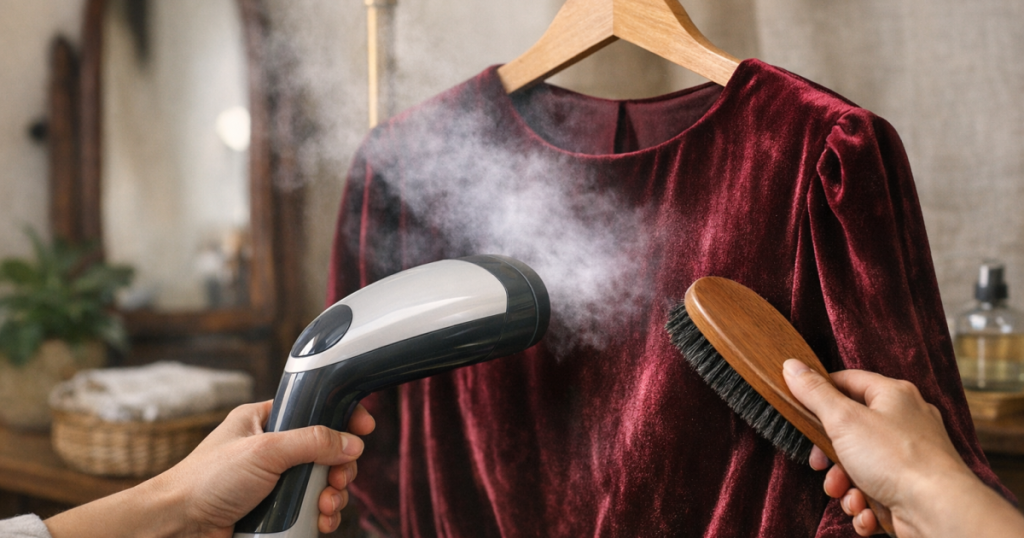
Hold the steamer head a few centimetres away rather than touching the surface. The exact distance depends on the strength of your appliance and the fabric’s response, so start farther away and move closer only if needed. You want the fibres to soften, not become wet or hot to the touch.
If you are using a steam iron vertically, use only the steam burst or vertical steam function and keep the soleplate off the velvet. A conventional iron can be useful for other laundry, but velvet is one fabric where contact pressure is the problem. If you need a refresher on everyday steam iron behaviour and trade-offs, our Tefal and Philips steam iron comparison explains the sort of steam delivery differences readers often notice in normal home use.
4. Work in short downward passes
Steam in small sections, moving downward with the grain of the pile where you can. Do not hold the steam in one place. For sleeves, let the sleeve hang naturally and steam around it rather than squeezing it flat. For hems, support the garment from the inside by holding a seam or lining edge, keeping your fingers away from the steam path.
5. Encourage the nap gently
After a brief steam pass, allow the pile to lift on its own. If it needs help, use a very soft clothes brush or your fingertips to coax the nap in its natural direction. Do not scrub. A barely-there brushing motion is enough. On expensive, antique or silk velvet, skip brushing unless you have tested first, because even soft friction can alter the surface.
6. Let it dry untouched
Once the creases have relaxed, leave the garment hanging until it is fully cool and dry. This is not just about comfort; pile can reset while warm and damp. If you sit down in a velvet dress or pack a velvet jacket too soon after steaming, the pressure can create fresh marks exactly where the fabric touches a chair, hanger or fold.
What to do with stubborn creases
Some creases in velvet are pressure marks rather than ordinary wrinkles. These often appear where a garment has been folded under weight, clipped tightly, trapped in a crowded wardrobe or packed in a suitcase. They may not disappear in one steaming session.
For a stubborn crease, steam lightly from the reverse, then let the garment hang overnight. Repeat once if needed. Avoid the temptation to press it between a towel and an iron; that can drive the pile flat. If a mark remains shiny and smooth even after the fibres are dry, it may be a crushed pile mark rather than a crease.
For small crushed areas, you can try holding the marked section over steam without touching it, then lifting the nap lightly with a soft brush once cool enough to handle. Work from the edges of the mark rather than attacking the centre. Stop if the colour or texture starts to look uneven.
Mistakes that cause shiny patches
- Pressing directly on the velvet: even a light touch from a hot soleplate can flatten the fibres.
- Using too much water: wet velvet can dry with tide marks or a distorted nap.
- Steaming against a hard surface: pressure from a door, wall or board can imprint the pile.
- Brushing while damp: aggressive brushing can drag fibres out of alignment.
- Folding before dry: warm damp velvet creases quickly under its own weight.
- Ignoring trims and linings: beads, glue, interfacing and shoulder pads may react differently from the outer fabric.
Aftercare: drying, wearing and storing
Velvet should be left to air in a well-ventilated room after steaming. Do not put it over a radiator, in a tumble dryer or in direct strong heat. Heat can make the base cloth shrink or distort, while pressure from rails or clips can create new marks.
If you are refreshing several delicate garments indoors, manage the room moisture as well as the fabric. Open a window briefly when practical or use gentle ventilation so the garment dries evenly. For more delicate-fabric drying habits, see our advice on drying delicates indoors without heat damage.
When storing velvet, give it breathing room. Crowding a velvet blazer tightly between wool coats can crush the pile along the sleeves and lapels. Use a breathable garment bag for special pieces rather than plastic, and avoid tight folds for long periods. If folding is unavoidable for travel, place acid-free tissue or a clean soft cloth between folds and unpack the garment as soon as you arrive.
When steaming is not the right fix
Steam is useful for light creasing, packing wrinkles and general freshening, but it is not a cure for every velvet problem. Do not steam greasy marks, perfume stains, deodorant build-up or unknown spots before assessing them, because heat and moisture can spread or set residue. Do not steam velvet that feels unstable, sheds heavily or has a damaged backing.
Heavily structured velvet tailoring is also worth treating with caution. Jackets with canvassing, shoulder pads and shaped lapels can lose their line if they become too damp. For these, light steaming from a distance is usually safer than heavy treatment, and some garments are better refreshed by hanging in a steamy room for a short period rather than being targeted directly.
Main points
Velvet needs a no-pressure approach. Hang it well, test first, use steam sparingly, and keep the hot surface away from the pile. Work from the reverse where possible, move in short passes, and let the garment cool and dry fully before wearing or storing it.
The aim is not to make velvet perfectly flat like cotton shirting. The aim is to relax creases while preserving the raised nap, soft handle and natural variation in the fabric’s sheen.
FAQ
Can I steam velvet clothes with a normal iron?
Yes, but only by using vertical steam while keeping the soleplate away from the fabric. Do not press the iron onto the velvet, even through a cloth, unless the care label gives specific instructions and you have a proper velvet needle board.
Should velvet be steamed inside out?
Inside out is usually safer for unlined garments because steam reaches the base fabric without direct contact with the pile. For lined or structured garments, do not turn them inside out if it pulls the shape out of place.
How do I fix a shiny mark on velvet?
Try light steam from a distance, let the area cool, then gently lift the nap with a soft brush if testing shows it is safe. If the fibres have been permanently crushed or heat-damaged, the shine may not fully disappear.
Can I use shower steam on velvet?
Shower steam can help with mild creases, but keep the garment away from splashes and condensation. Hang it outside the direct wet zone and allow it to dry fully in a ventilated room afterwards.
Is steaming safe for silk velvet?
Silk velvet is high-risk because it can watermark and crush very easily. Use minimal steam from a distance, test first, avoid brushing aggressively, and stop immediately if the surface changes.