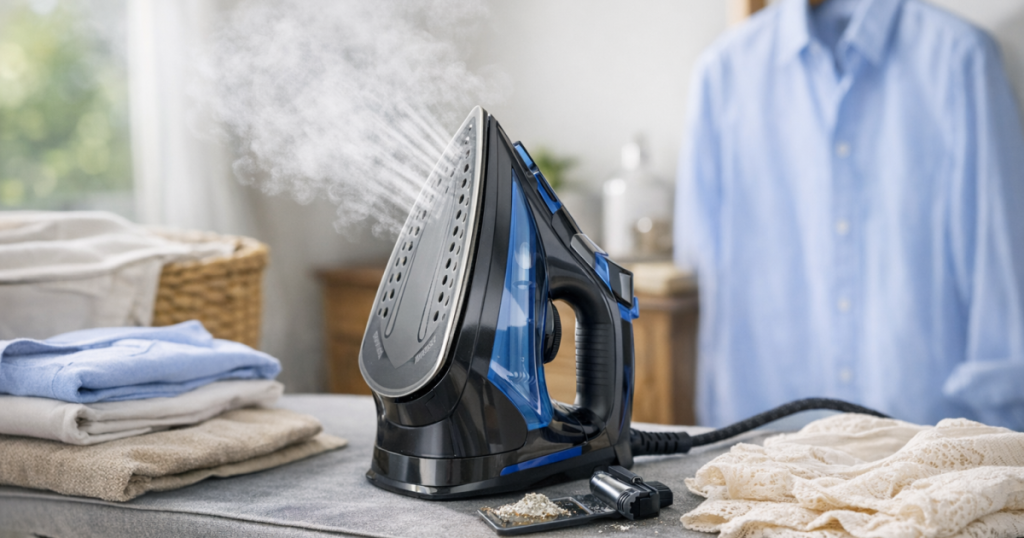
Creased school shirts, work blouses and cotton bedding are where a steam iron earns its keep. This Tefal Ultraglide Anti-Calc Plus FV5872 review focuses on fabric results, scale control, ease of handling and whether it makes sense for a UK home that irons regularly rather than occasionally.
In brief
The Tefal Ultraglide Anti-Calc Plus FV5872 is worth considering if you want a full-size steam iron for everyday cottons, polycotton uniforms, shirts, pillowcases and household laundry, and you live in an area where limescale makes cheap irons feel disposable. Its appeal is practical rather than flashy: steady steam, a soleplate designed to glide easily, and an anti-calc system intended to make maintenance less of a chore.
It is less compelling if you rarely iron, mostly refresh delicate viscose or silk, or want the lightest possible appliance for quick touch-ups. For those uses, a garment steamer or a smaller iron may feel easier. But for a household that still presses collars, cuffs, pleats and seams, the Tefal Ultraglide Anti-Calc Plus FV5872 sits in the sensible middle ground: more capable than a basic budget iron, without needing the storage space of a separate steam generator.
How the FV5872 fits into everyday garment care
a good steam iron does three jobs at once: it relaxes fibres with moisture, uses heat to soften creases, and applies pressure to flatten the fabric. That combination is why an iron is still better than a steamer for crisp shirt fronts, trouser creases, uniform collars and cotton bedding. If you want a deeper explanation of the process, the principles are covered clearly in how steam, heat and pressure smooth clothes safely.
The FV5872 is a traditional corded steam iron, so its strongest use case is planned ironing rather than last-minute garment refreshing. It suits a board-based routine: filling the tank, sorting a small pile by fabric temperature, and working through cottons, synthetics and mixed fibres with the correct setting. That matters because the right iron can still damage clothing if it is used too hot, left in one place too long, or pressed directly onto sensitive finishes.
What stands out in use
Steam for shirts, bedding and uniforms
The reason to choose this type of iron over a very basic model is steam consistency. For cotton shirts and school uniform, steam helps relax set-in creases around cuffs, button plackets and hems. You should still expect to slow down on dense areas: collars and seams usually need a little pressure, a pause for the steam to work, and a final pass from the point of the soleplate.
For households washing several shirts a week, the advantage is not just speed. Better steam can reduce the temptation to turn the temperature too high, which is where shine, scorching and heat marks become more likely. On pale cotton this may not be obvious straight away; on dark trousers and synthetic blends, it can show quickly.
Anti-calc design for hard-water homes
Limescale is a real issue across many parts of the UK, particularly in hard-water areas. Scale can reduce steam performance, leave chalky marks, and shorten the useful life of an iron if maintenance is ignored. The anti-calc focus of this Tefal model is therefore a meaningful feature, not just a label.
The important point is that anti-calc does not mean maintenance-free. You still need to follow Tefal’s cleaning instructions, empty the tank after use if the manual recommends it, and avoid adding anything to the water tank unless the manufacturer explicitly allows it. Scented ironing water and improvised descaling mixtures can cause more problems than they solve if they are not suitable for the appliance.
Soleplate glide and control
A smooth-gliding soleplate matters most when ironing large flat areas: duvet covers, table linen, shirt backs and cotton dresses. If an iron drags, people tend to press harder, which can stretch fabric or create shine on darker garments. The FV5872 is designed for easy movement, but the real test is how cleanly the soleplate moves across mixed-fibre laundry once steam is in use.
Keep the soleplate clean and avoid ironing over printed logos, plastic trims or residue from stain removers. If residue builds up, glide worsens and marks can transfer to pale clothing. This is particularly relevant for workwear and schoolwear, where badges, logos and synthetic panels are common.
Fabric-by-fabric suitability
The FV5872 makes most sense for fabrics that benefit from proper pressing. It is strongest on cotton, linen blends, polycotton shirts, pillowcases and heavier everyday garments that need both steam and pressure. It can also be useful on jeans and chinos, provided you use the right setting and iron from the reverse where needed.
- Cotton shirts: A good match. Use steam, work from collar to cuffs, and iron slightly damp shirts for easier crease removal.
- School uniforms: Usually suitable for shirts, skirts and trousers, but check care labels because many are polyester-rich and can shine if overheated.
- Dark trousers: Use a pressing cloth or iron inside out. For more detail, see whether pressing cloths prevent shine on dark trousers.
- Viscose and delicate blends: Use caution. Low heat, minimal pressure and reverse-side ironing are safer, and steaming may be the better route for some garments.
- Printed or embellished clothing: Avoid direct contact with prints, transfers, sequins and coated details.
This is where a powerful steam iron can be both helpful and unforgiving. It gives you more crease-removing ability, but it also asks you to respect the care label. Sort garments before ironing rather than jumping between linen, polyester and viscose on the same high setting.
Where it may disappoint
The FV5872 is not the right answer for every home. If you only iron once a month, its anti-calc and steam advantages may not matter enough to justify choosing it over a simpler iron. If you have wrist strain or prefer very lightweight tools, check the filled weight in person if possible, because a full water tank can change how comfortable any steam iron feels over a longer session.
It is also not a substitute for a steam generator if you regularly tackle large piles of bedding or heavy linen. A steam generator has a separate water tank and is built for longer, higher-volume sessions, though it takes more space and usually costs more. The FV5872 is better viewed as an upgraded everyday iron for normal household loads.
For delicate-heavy wardrobes, the question is different. A handheld steamer will not create the same crisp finish on collars and trouser creases, but it can be gentler for hanging garments and awkward shapes. If viscose is a regular frustration, it is worth reading whether a garment steamer or steam iron is safer for viscose before deciding.
Useful checks before buying
Retail listings can vary in how they present steam output, wattage, water tank details and included features, so check the current product page and the packaging rather than relying on a short marketplace summary. For the FV5872, pay particular attention to the details that affect daily use rather than headline claims alone.
- Anti-calc maintenance: Check how the collector or cleaning system is emptied, how often Tefal recommends cleaning it, and whether the instructions suit your routine.
- Auto-off information: Confirm the safety features on the exact model being sold, especially if you are comparing retailer bundles or similar-looking variants.
- Steam controls: Look for controls that feel simple enough to adjust between cotton, synthetics and delicates without guesswork.
- Water filling: Check whether the opening and tank visibility look practical for your sink setup and eyesight.
- Soleplate care: Make sure replacement advice and cleaning instructions are easy to follow, as a dirty soleplate can undo the benefits of a better iron.
- Warranty and returns: Verify the retailer’s policy in the UK before purchase, particularly if buying online.
If you are also considering alternatives, compare it with another established full-size steam iron such as the Philips Azur Elite Steam Iron on the points that matter to your laundry habits: comfort in hand, fabric settings, scale management and how easy it is to store near your ironing board.
How to get better results from it
The best results come from using the iron as part of the whole laundry process, not as a rescue tool after clothes have dried into hard creases. Remove shirts promptly from the washing machine, shake them out, and hang or lay them neatly before ironing. Slightly damp cotton is easier to press than bone-dry cotton.
- Start cool: Begin with synthetics and delicate blends, then move to cottons and linens as the iron heats.
- Use steam with patience: Let steam penetrate stubborn creases instead of repeatedly scrubbing the soleplate back and forth.
- Protect dark fabrics: Use a pressing cloth, iron inside out, and avoid excessive pressure.
- Empty and store properly: Follow the manual on emptying water and storing the iron upright to reduce leaks and residue.
- Clean before marks appear: Do not wait until white flakes or brown marks show on clothing before dealing with scale or soleplate residue.
Is it worth buying?
Yes, the FV5872 is worth buying for a UK household that irons regularly and wants a capable steam iron with practical scale management. It is a particularly sensible choice for families dealing with work shirts, uniforms, cotton bedding and mixed weekly laundry, where a cheap low-steam iron can make the job slower and less consistent.
It is not the most logical purchase for occasional ironing, travel use, or wardrobes built mainly around delicate draped fabrics. In those cases, a simpler iron, a steamer, or a different setup may be a better match. But if your priority is a crisp finish on everyday garments without moving up to a bulky steam generator, this Tefal deserves a place on the shortlist.
Common questions
Can I use tap water in the Tefal FV5872?
Follow the Tefal manual for the exact water advice. In hard-water areas, anti-calc maintenance becomes more important, even if the iron is designed to manage scale better than a basic model.
Is it safe for polyester school uniform?
Usually, but only on the correct low or medium setting shown on the garment care label. Iron inside out where possible and avoid lingering on pleats, logos or shiny synthetic panels.
Does an anti-calc iron still need cleaning?
Yes. Anti-calc systems reduce scale problems; they do not remove the need for routine cleaning. Empty or clean the collector according to the manufacturer’s instructions.
Would a steamer be better for work shirts?
A steamer is useful for freshening and light creases, but an iron is better for crisp collars, cuffs and button plackets. Many homes benefit from one main iron rather than relying on steaming alone.
Should I use a pressing cloth with this iron?
Use one on dark trousers, wool blends, delicate synthetics and anything prone to shine. The better the iron, the more important it is to control direct heat and pressure.