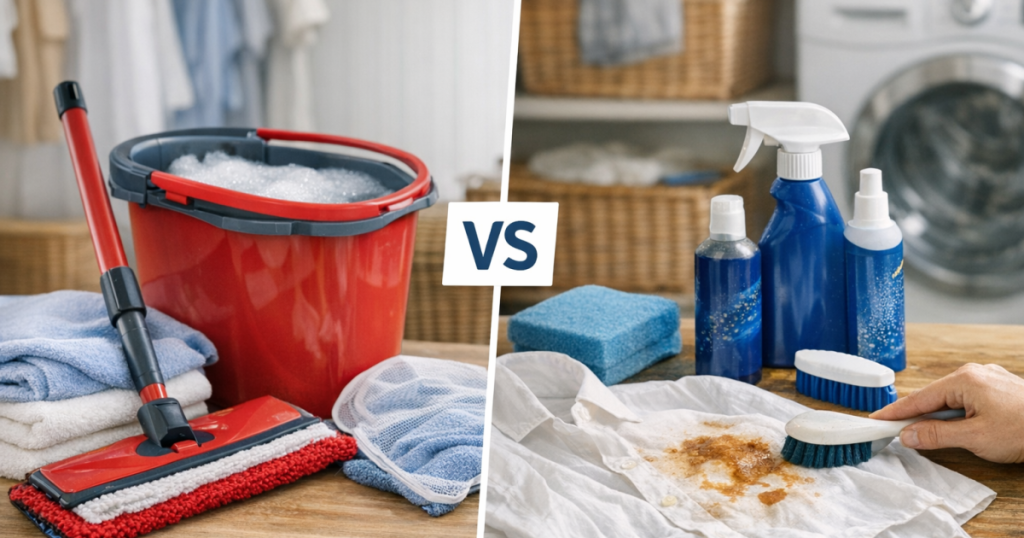
A cleaning kit and a laundry stain remover sound like they belong in the same cupboard, but they do very different jobs. Vileda vs OxiClean is really a choice between improving the space where you care for clothes and treating stains on washable garments before they go in the machine. If your problem is dust, lint and grime around the utility room, Vileda makes more sense. If your problem is food, sweat, make-up or oily marks on clothing, OxiClean is the more relevant fabric-care buy.
Quick Buying Links
Vileda 2-in-1 Cleaning Kit
In brief The Vileda 2-in-1 Cleaning Kit is best understood as a household cleaning support product.
OxiClean MaxForce Stain Remover Kit
OxiClean MaxForce Stain Remover Kit The OxiClean option is a direct laundry pre-treatment.
In brief
The Vileda 2-in-1 Cleaning Kit is best understood as a household cleaning support product. It can help keep floors, hard surfaces or laundry-adjacent areas cleaner, depending on the exact kit contents you buy. That matters because clean worktops, airing areas and utility spaces reduce the chance of transferring dust, pet hair, residue or general grime onto freshly washed clothes.
The OxiClean MaxForce Stain Remover is the more direct garment-care option. It is designed for pre-treating marks on washable fabrics before laundering. For readers trying to rescue school shirts, workwear, sports kit, baby clothes or everyday cotton tops, it addresses the stain itself rather than the room around the laundry basket.
The key decision is simple: choose Vileda if your fabric-care problem starts with a messy laundry environment; choose OxiClean if marks are already on the fabric. Many homes would use both, but they are not interchangeable.
Standout choice by problem
- For visible garment stains: OxiClean MaxForce is the more appropriate choice because it is applied to washable fabric before the wash cycle. Always check the garment care label and test colours first.
- For dusty utility rooms, lint-prone surfaces and cleaning around drying areas: Vileda is the better fit because it supports the home setup around laundry rather than treating fibres directly.
- For uniforms and repeated stains: OxiClean is more useful if the fabric is washable and colourfast, while Vileda helps keep the laundry area clean between loads.
- For delicate fabrics: neither should be used casually on silk, wool, velvet or specialist finishes. Use the care label and fabric-specific advice before applying any treatment.
- For a first purchase: buy according to the problem you notice most often. A stain remover will not clean a utility floor, and a cleaning kit will not remove tomato sauce from a shirt cuff.
What each product is actually for
Vileda 2-in-1 Cleaning Kit
The Vileda option sits in the home-cleaning side of garment care. It is useful where clothes are sorted, dried, folded or ironed in spaces that collect lint, dust, detergent drips or outdoor dirt from shoes. The exact contents can vary by retailer and listing, so check what is included before buying rather than assuming it contains a particular cloth, mop head, brush or handle.
For clothing care, its value is indirect but still practical. A cleaner laundry space means fewer dust marks on white shirts, less pet hair landing on dark knitwear while folding, and less grime building up around hampers or drying racks. It is particularly relevant in UK homes where washing may be dried indoors during wet weather, often in kitchens, spare rooms, bathrooms or utility corners rather than a dedicated laundry room.
It is not a textile stain remover. You should not treat it as a way to scrub marks out of garments, and you should avoid using household surface-cleaning residues directly on clothing. If a garment has a stain, use a laundry-safe pre-treatment and follow the wash label.
OxiClean MaxForce Stain Remover Kit
The OxiClean option is a direct laundry pre-treatment. It is meant for stains on washable clothing before laundering, not for cleaning floors, baskets or drying areas. If sold as a kit or bundle, check the exact product format, bottle size and any included applicators because listings can differ.
Its main appeal is targeted treatment. Instead of putting a marked item straight into the drum and hoping detergent alone will shift it, you apply a stain remover to the affected area, allow it to work for the time stated on the label, then wash as directed. This can be useful for collar grime, food splashes, grass marks, deodorant build-up and everyday oily stains, provided the fabric and dye are suitable.
For a broader approach to choosing pre-treatment products, the advice in how to choose a stain remover kit for everyday clothes is a useful next step, especially if your wardrobe includes mixed fibres, children’s clothing, work shirts and dark colours.
Side-by-side comparison
- Main job: Vileda helps clean the home environment around laundry; OxiClean helps pre-treat stains on washable garments.
- Best use case: Vileda suits utility rooms, hard surfaces and lint-prone laundry zones; OxiClean suits marked clothes before machine washing.
- Fabric contact: Vileda should generally stay away from direct garment treatment unless the specific item included is clearly intended for textiles; OxiClean is intended for fabric use where the label permits it.
- Risk to clothing: Vileda can transfer cleaning residues if used carelessly around folded clothes; OxiClean can affect colour or finish if used on unsuitable fibres or left on incorrectly.
- Most useful for families: OxiClean is more useful for frequent school, food and sports stains; Vileda is useful for keeping shared laundry spaces tidy and less dusty.
- Most useful for renters or small flats: Vileda can help when drying and folding happen in multi-use rooms; OxiClean helps when you have limited chances to rewash failed stain attempts.
- Delicate fabric suitability: both require caution. OxiClean should only be used where the garment label and product instructions allow; Vileda should not be treated as a delicate-fabric tool.
- Long-term value: Vileda supports cleaner routines over time; OxiClean earns its keep when stains are common enough to justify a dedicated pre-treatment.
Where Vileda fits into a garment-care routine
Vileda makes the most sense when clothing problems are caused by the surroundings rather than the wash itself. Dusty skirting boards beside an airer, pet hair on hard floors, detergent residue on a worktop, and lint gathering under an ironing board can all end up back on clean clothes. A simple cleaning kit can reduce that transfer.
This is particularly relevant if you dry knitwear flat, fold shirts on a kitchen table, store off-season clothes in boxes, or use a heated airer in a living space. Keeping those areas clean helps prevent fresh marks and stale smells from creeping into garments after washing. If odour is the bigger issue, especially after storage, see how to remove musty smells from stored clothes safely before reaching for stronger fragrance or repeated hot washes.
The trade-off is that Vileda does not solve a stain that is already bonded to fabric. It is a prevention and housekeeping purchase, not a rescue treatment. If you are buying one product because a favourite shirt has curry sauce on it, Vileda is the wrong tool.
Also think about residue. If you use sprays or household cleaners with the kit, keep them away from garments, ironing surfaces and areas where damp clothes will be laid flat. Some cleaning products are designed for hard surfaces and may leave marks, scent or chemical residue if they contact fabric.
Where OxiClean earns its place
OxiClean is stronger as a decision when the stain is the main problem. It is most relevant for washable, everyday fabrics: cotton T-shirts, polycotton school shirts, many work trousers, aprons, sports tops and casual clothing. It can be a useful step before a normal 30°C or 40°C wash, depending on the garment label and detergent instructions.
The practical advantage is timing. Stains are usually easier to deal with before they are washed, dried and ironed. Heat can set some marks, so a pre-treatment gives you a chance to loosen the stain before the main wash. That does not guarantee removal, but it is a more fabric-aware approach than repeatedly washing at higher temperatures and hoping for the best.
For work clothing, the decision also depends on what the garment is for. Healthcare scrubs, for example, need careful handling because colour retention, shrinkage and hygiene all matter. If that is your use case, read how to wash healthcare scrubs without fading or shrinking before adding extra pre-treatments to your routine.
The limitation is fabric suitability. A stain remover that works well on a robust cotton top may be wrong for silk, wool, velvet, leather trims, waterproof finishes or garments labelled dry clean only. Colourfastness matters too. Always test an inconspicuous area and follow the product label rather than assuming a stain remover is safe on every item in the basket.
Fabric risks and care-label checks
The biggest mistake with this comparison is treating both products as general-purpose problem solvers. They are not. One is a cleaning tool for the home; the other is a laundry pre-treatment. Using either outside its intended role can create new problems.
- Check the garment label first: if the label says dry clean only, do not apply a domestic stain remover without specialist advice from a cleaner.
- Test colourfastness: dab a small hidden area and check for dye transfer or lightening before treating a visible stain.
- Avoid scrubbing hard: aggressive rubbing can fuzz cotton, distort jersey, damage prints and weaken fibres around the stain.
- Do not mix cleaning products: combining laundry and household cleaners can create residues and unpredictable results.
- Keep surface tools separate: do not use the same cloth or pad on floors and then near clean laundry or ironing areas.
- Watch treated areas after washing: if a stain remains, avoid tumble drying or ironing until you have reassessed it.
For delicate items, the safest comparison may be neither product. A silk pillowcase, velvet dress or wool jumper needs a gentler fabric-specific method, not a household cleaning approach or an aggressive stain attempt.
Cost and value without getting distracted by price
Prices and bundle contents can change, so it is more useful to think in terms of cost per problem solved. Vileda gives value if you will use it weekly around the areas where clothes are washed, dried, folded or ironed. If it ends up hidden under the sink while clothes are folded on dusty surfaces, it will not improve your fabric-care routine.
OxiClean gives value if stains are frequent and varied. A dedicated pre-treatment is easier to justify in homes with children, uniforms, gym kit, workwear, cooking aprons or light-coloured clothing. It is less compelling if your laundry is mostly dark, lightly worn and rarely stained.
Before buying either, check the retailer listing carefully. For Vileda, confirm what is included and whether replacement heads, cloths or pads are available if relevant to that kit. For OxiClean, confirm the exact format, usage instructions, fabric warnings and whether the product is suitable for the colours and materials you wash most often.
Which one suits your laundry setup?
Choose Vileda if your problem is transfer dirt
Choose Vileda if clean clothes often pick up dust, pet hair or grime after washing. This can happen when clothes are folded on dining tables, aired near skirting boards, stored beside shoes, or ironed in rooms that are not cleaned as often as the kitchen or bathroom. It is also sensible if your laundry space doubles as a hallway, utility corner or boot room.
Its benefit is routine control. You are not treating one dramatic stain; you are reducing the background mess that makes clothes look less fresh after you have already washed them.
Choose OxiClean if your problem is visible staining
Choose OxiClean if your main frustration is marks that survive a normal wash. It is the more logical purchase for food spills, collar grime, underarm marks, grass, mud, make-up and oily splashes on washable clothes. It is also useful when you want to avoid jumping straight to hotter washes, which can be rougher on colour, elastane and some garment finishes.
Its benefit is targeted action. You apply it where the problem is, rather than changing the whole wash routine for one stained garment.
Use both if you manage a busy household wash
In a busy home, the products can complement each other. Vileda keeps the laundry environment cleaner; OxiClean deals with the marks that arrive on clothes anyway. That combination is most useful where school uniforms, workwear, sports clothing, towels and everyday clothes all move through the same small drying and folding space.
The important boundary is separation. Keep household cleaning tools for surfaces and laundry stain treatments for garments. Do not blur the two just because both sit near the washing machine.
Things readers ask
Can I use a Vileda cleaning kit directly on clothes?
Only use it on clothing if the specific component is clearly intended for textiles. Most household cleaning tools are designed for surfaces, so they are better kept away from garments, especially delicate fabrics and anything freshly washed.
Is OxiClean MaxForce suitable for all fabrics?
No. Treat it as a washable-fabric pre-treatment and follow the product label. Avoid guessing with silk, wool, velvet, leather trims, waterproof coatings and dry-clean-only garments.
Should I pre-treat stains before every wash?
No. Pre-treat visible or likely stubborn marks. Routine pre-treatment on clean areas wastes product and may expose fabrics to unnecessary chemical action.
Which is better for school uniform?
OxiClean is usually the more relevant option for food, pen, grass and collar marks on washable uniform. Vileda helps keep the drying and folding area clean so washed uniform does not pick up dust or hair.
Can either product replace good detergent?
No. A cleaning kit supports the laundry environment, and a stain remover targets specific marks. You still need a suitable laundry detergent and the correct wash programme for the fabric.
The sensible choice for most fabric-care routines
If you are buying for garment stains, choose OxiClean MaxForce Stain Remover and use it carefully on washable, colourfast fabrics. It is the more direct solution for the problem most people mean when they compare these two products: marks on clothing that need attention before washing.
If your clothes come out clean but pick up dust, lint or pet hair while drying, folding or ironing, choose the Vileda 2-in-1 Cleaning Kit instead. It will not rescue a stained shirt, but it can make your laundry setup cleaner and less likely to undo your work.
For many UK homes, the best answer is not one product replacing the other. Use Vileda to keep the laundry area clean, and keep a laundry-safe stain remover such as OxiClean for washable garments that need targeted pre-treatment. The right choice depends on whether the problem is on the fabric or around it.
Quick Buying Links
Vileda 2-in-1 Cleaning Kit
In brief The Vileda 2-in-1 Cleaning Kit is best understood as a household cleaning support product.
OxiClean MaxForce Stain Remover Kit
OxiClean MaxForce Stain Remover Kit The OxiClean option is a direct laundry pre-treatment.