A snagged camisole strap or pulled lace edge usually happens when delicate fabric rubs against zips, hooks, drum holes or heavier garments. For many delicates, mesh laundry bags give those items a protective layer in the wash, but they work best when you treat them as one part of a gentler laundry routine rather than a cure-all. The aim is to reduce friction, prevent tangling and keep trims from catching before damage starts.
The short answer
Yes, a wash bag can help stop delicates snagging, but it cannot make every delicate garment machine-safe. It is most useful for small, lightweight or detailed items that are already suitable for washing at home.
- It helps with friction: the bag keeps delicate surfaces away from rougher garments, zips and buttons.
- It helps with tangling: straps, ties and lace edges are less likely to wrap around other clothes.
- It does not fix the wrong cycle: a harsh wash, hot water or fast spin can still distort fibres.
- It does not protect from poor sorting: a bag placed in a load with jeans, towels or heavy workwear is still under strain.
How snagging happens inside the machine
Snagging is rarely caused by one dramatic moment. It is usually the result of repeated rubbing, twisting and catching during the wash and spin. Fine knits can be pulled by metal fastenings, lace can catch on hook-and-eye closures, and satin-like finishes can roughen when they rub against coarse cottons or synthetic sportswear.
The spin stage is often the roughest part for delicate garments. Even when the wash action is fairly gentle, high-speed spinning can force small items against the drum and other garments. That is why a bag needs to be combined with sensible sorting, the right programme and a measured load size.
Your laundry set-up also matters. Keeping spare bags, a stain cloth, mild detergent and a clear sorting space near the machine makes it easier to separate delicate items before they disappear into the main wash. If your routine often feels rushed, a more protective layout can help; see our guide to setting up a laundry area that protects clothes.
Where mesh laundry bags help most
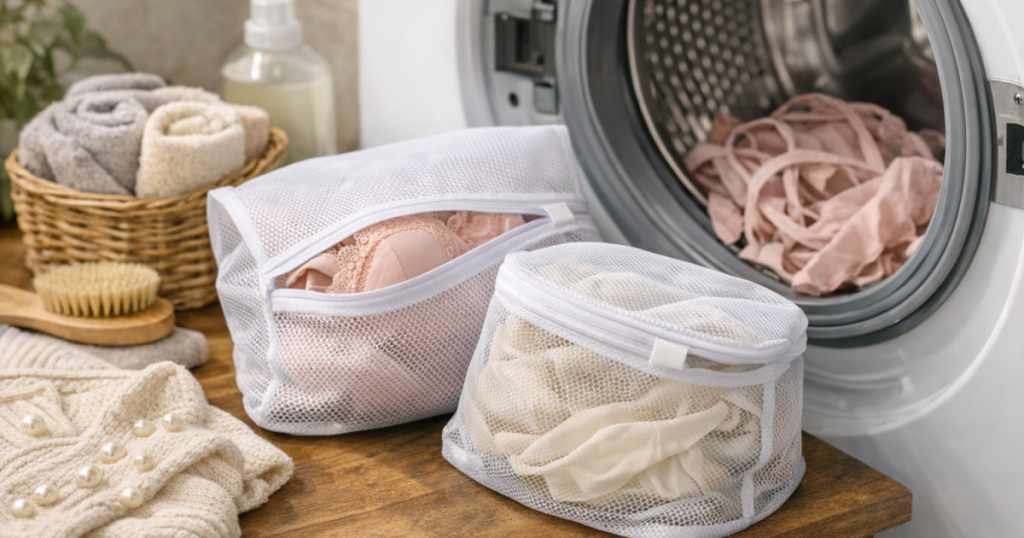
Mesh laundry bags are especially useful for garments that are washable but vulnerable to catching. They create a soft barrier without sealing the item away from water and detergent. The mesh lets the wash move through, while reducing direct contact with abrasive surfaces.
Lingerie and bras
Bras, bralettes and delicate knickers are among the strongest candidates for a wash bag. Fasten hooks before washing so they do not catch on lace or mesh panels. Moulded cups should not be crushed into an overfilled bag, and wired bras need extra care because twisting can distort their shape over time.
Hosiery and tights
Tights, sheer socks and fine hosiery can ladder when they meet a zip, rough seam or hook. A fine-mesh bag helps keep them contained and reduces tangling. Avoid washing them with garments that have Velcro-style fastenings, heavy metal trims or exposed zips.
Lace, embroidery and appliqué
Decorative stitching, open lace and small trims can catch easily. Turn the garment inside out, close any fastenings, then place it in a bag with enough room for water to circulate. If the decoration is glued, beaded or very fragile, the care label may still point you away from machine washing.
Lightweight viscose, silk blends and satin finishes
Smooth, fluid fabrics can develop pulled threads or surface scuffing when washed with heavier fabrics. A bag can reduce rubbing, but it will not prevent shrinkage, colour loss or distortion if the garment is washed against its care instructions. Use the gentlest suitable programme and avoid overcrowding.
Small children’s clothes and uniform details
Small school items, detachable collars, fabric belts and uniform accessories can get trapped in larger loads. A bag keeps them together and reduces the chance of straps and ties wrapping around other garments. It also makes it easier to find small items before drying.
What a laundry bag cannot protect against
A bag reduces mechanical damage, but it does not cancel out heat, dye transfer, unsuitable detergent or aggressive spin speeds. If a garment says hand wash only, a bag does not automatically make a normal machine cycle safe. If it says dry clean only, treat that instruction seriously, especially for structured garments, linings, interfacings or delicate embellishment.
It also will not remove existing fabric problems. Pilling, fuzzing and loose fibres need different treatment from snag prevention. For knitwear, gentle de-pilling tools may be more relevant after washing; our guide to whether cashmere combs protect knitwear better than shavers explains the trade-off for softer fibres.
How to use a wash bag without creating new problems
The biggest mistake is treating the bag as a licence to wash everything together. Use it as a controlled space for vulnerable garments, not as a shield against a rough load.
Step 1: Check the care label first
Start with the label, not the bag. Check whether the garment is machine washable, hand wash only or dry clean only. Look for temperature guidance, spin restrictions and drying instructions. If the label is missing, judge by fabric, construction and value: loosely woven, embellished, lined or structured garments deserve the most caution.
Step 2: Close anything that can catch
Fasten hooks, buttons and zips before bagging. Tie loose sashes loosely so they cannot knot around the garment. Turn textured or decorated pieces inside out. This reduces the number of edges exposed to the mesh and to the garment itself.
Step 3: Do not overfill the bag
Give each garment enough space to move. A tightly packed bag can stop detergent rinsing properly and may leave creases set into delicate fabric. As a simple rule, one bra or a small number of lightweight pieces per bag is usually safer than stuffing several items together.
Step 4: Sort the main load carefully
Place delicate bags in a compatible load: similar colours, similar fabric weight and no rough fastenings. Avoid mixing them with towels, denim, heavy cotton sweatshirts or garments with exposed hardware. A delicate bag in a harsh load is still being knocked around by heavy fabric.
Step 5: Choose a gentle cycle
Use the mildest cycle that suits the garment and soil level. A cool wash is often kinder to dyes and elastic fibres, but the care label should guide the exact temperature. If your machine allows it, select a lower spin for delicate items to reduce twisting and stretching.
Step 6: Remove items promptly
Do not leave delicates sitting damp in the drum or inside the bag for long periods. Remove them, check for tangles, reshape gently and dry according to the label. Drying can undo careful washing if the method is too hot or too rough, so it is worth matching the fabric to the right aftercare; this guide to choosing the right drying method for each fabric is a useful next step.
Choosing the right type of bag for the job
You do not need an elaborate collection, but the bag should suit the garment. Fine mesh is better for hosiery, lace and small trims because it gives fewer catching points. A slightly sturdier bag can work well for bras or small accessories, provided it is not so rigid that it crushes the item.
- Fine-mesh flat bags: good for tights, slips, lace knickers, camisoles and small delicate tops.
- Structured lingerie bags: useful for bras where you want to reduce crushing as well as snagging.
- Larger garment bags: better for lightweight blouses or knit tops that need room to move.
- Zip-cover designs: helpful because the zip pull is less likely to tap the drum or catch on another item.
Check the bag itself regularly. A rough zip, broken seam or torn mesh can create the very snagging risk you are trying to avoid. Wash bags also pick up lint and loose threads, so shake them out and let them dry fully between uses.
Common mistakes that lead to snags anyway
- Putting delicates in with towels: towel loops and heavy wet fabric can pull at fine fibres.
- Leaving bra hooks open: hooks can catch the garment itself, even inside a bag.
- Using one oversized bag for everything: items can still tangle together inside the bag.
- Ignoring embellishments: sequins, beads and glued trims may not tolerate machine washing.
- Spinning too hard: a fast spin can stretch straps, distort knitwear and crease delicate fabrics sharply.
- Drying badly afterwards: heat and hanger marks can damage items that survived the wash itself.
Quick answers
Can I put several delicate items in one bag?
Yes, if they are similar in colour, weight and construction, and the bag is not crowded. Keep bras separate from lace or hosiery so hooks and wires do not press into finer pieces.
Are wash bags enough for wool or cashmere?
Not on their own. Wool and cashmere need the correct care label guidance, low agitation and careful drying. A bag can reduce rubbing, but it will not prevent felting if the wash action, heat or detergent is unsuitable.
Should the bag be zipped fully closed?
Yes. Close the zip fully and tuck the pull into its cover if the bag has one. A half-open bag can release garments during the cycle and may create another catching point.
Can a pillowcase replace a laundry bag?
A clean pillowcase can work in a pinch for some washable delicates, but it is less ideal because it may hold more water, reduce rinsing and knot if tied badly. A purpose-made mesh bag generally allows better water flow.
What to remember
A laundry bag is a useful fabric care tool, not a guarantee. It can reduce snagging by limiting friction, tangling and contact with rougher garments, but it needs help from the rest of your routine. Check the care label, close fastenings, sort by fabric weight, avoid overfilling, choose a gentle cycle and dry with the same level of care.
Used consistently, this small habit can make a noticeable difference to lace, hosiery, lingerie, lightweight blouses and delicate uniform details. The real win is not just fewer snags after one wash, but less cumulative wear each time those garments go through the machine.