A suede jacket can look flat, dusty or slightly stale long before it needs professional cleaning. The safest way to refresh a suede jacket is to work dry first, lift the nap gently, deal with odours through airing, and only introduce moisture after careful testing.
Suede is leather with a raised, velvety surface, so ordinary laundry habits can ruin it quickly. Avoid washing machines, soaking, hot steam and direct heat; the aim is to revive the surface, not clean it like a cotton jacket.
The short version
- Let the jacket dry fully before brushing or treating marks.
- Use a suede brush with light strokes, following the natural direction of the nap.
- Air the jacket in shade rather than masking odours with sprays.
- Test any damp cloth, eraser or protector on a hidden area first.
- Keep oil, perfume, fabric conditioner and household stain removers away from suede.
- Use a suede or leather specialist for heavy grease, dye transfer, mould or valuable jackets.
Start with a dry condition check
Before touching the nap, hang the jacket on a broad hanger and look at it in daylight. Check the shoulders, elbows, cuffs, pocket edges and collar, as these areas collect body oil, rain spotting and flattened fibres first.
Read the care label and note whether the jacket is real suede, nubuck, faux suede or a suede-trimmed garment. Real suede usually responds well to brushing, but bonded panels, dyed finishes, trims and delicate linings can react differently. If the colour looks unstable, use the same cautious approach you would use to test clothes for colourfastness before washing, keeping the test small and hidden.
Do not refresh suede while it is damp from rain. Wet nap is more vulnerable to distortion, so let the jacket dry naturally at room temperature, away from radiators, heated airers and sunny windows. Stuffing the sleeves loosely with acid-free tissue or clean white cloth can help the shape recover while it dries.
Brush the nap back to life
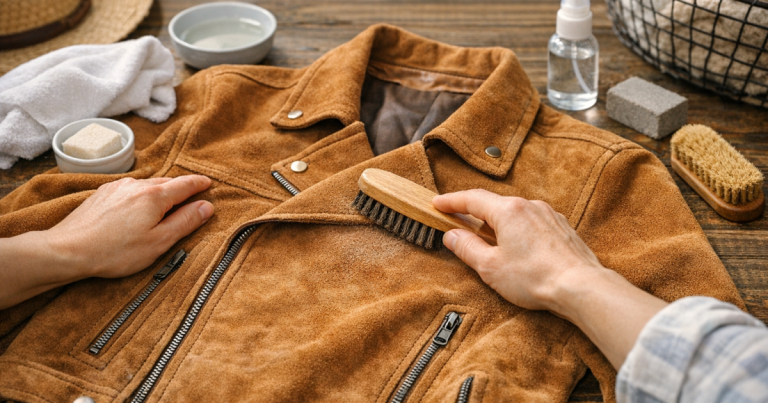
Once the suede is dry, use a proper suede brush or a clean crepe brush. Hold the jacket steady on a hanger or flat surface and brush lightly in one direction to remove dust and align the fibres. For flattened patches, use short strokes with slightly more lift, but do not scrub back and forth aggressively.
Work panel by panel rather than attacking the whole jacket at once. Start with less visible areas, such as the lower back or inside edge of a front panel, so you can judge how the nap responds. If the brush raises the pile evenly, continue over the shoulders, sleeves and front panels.
For dusty seams, use the edge of the brush gently along stitching lines. Avoid dragging hard across seams, as this can create pale track marks or roughen the stitching. If the jacket has decorative panels, embroidery, studs or beadwork, treat those areas as specialist surfaces rather than ordinary suede. The same slow-handling mindset used when cleaning beaded dresses without loosening embellishments applies here: support the fabric, avoid pulling, and do not force tools under raised details.
Deal with odour without wetting the suede
Most mild odours can be improved by airing. Hang the jacket in a shaded, well-ventilated place indoors, or outside only if the weather is dry and the jacket will not sit in direct sun. A covered porch on a dry day can work well, but a steamy bathroom or damp utility room is the wrong setting.
Do not spray perfume, fabric freshener or fabric conditioner directly onto suede. These can leave rings, dark patches or sticky residues that attract dust. If the lining smells slightly stale, turn the jacket inside out as far as the construction allows and air it with the lining exposed, without stretching the shoulders or sleeves.
For persistent wardrobe odour, place the jacket near, not touching, an open bowl of bicarbonate of soda in a closed cupboard overnight. Keep powder away from the suede itself, as fine residue can lodge in the nap and become difficult to remove.
Lift shiny or flattened patches
Shiny areas on suede are often caused by compressed nap rather than true shine. They commonly appear on elbows, cuffs, pocket flaps and seat-belt contact points. A suede eraser or soft suede block can help lift surface glazing if used carefully on dry suede.
Rub the affected area with very light pressure, then brush the loosened fibres back into alignment. Stop as soon as the patch improves. Overworking one spot can create a pale, abraded area that looks worse than the original flattening.
Do not iron suede to remove creases or flattening. Heat and pressure can crush the nap permanently. If the jacket has a satin lining that is creased, handle that fabric separately and avoid pressing through to the suede; the principles behind removing creases from satin without shine marks are useful for understanding why low pressure and fabric-specific handling matter.
Fresh rain marks and water spots
If the jacket has been caught in a shower, let it dry fully before deciding whether it needs more work. Once dry, brush the area gently to see whether the spot disappears as the nap lifts. Many light rain marks improve with brushing alone.
For a visible water edge, avoid dabbing one tiny spot repeatedly, as this can create a ring. A specialist suede cleaner may very lightly even out a whole panel, but at home the safer move is often to stop after dry brushing rather than add more moisture. If the jacket is expensive, pale coloured or strongly dyed, send it to a suede cleaner before the mark sets or spreads.
Collars, cuffs and body oil
Collars and cuffs are harder because they collect skin oils, hair products and make-up. Start with a clean suede brush, then use a suede eraser only on dry surface soiling. Brush again afterwards to restore texture.
Avoid washing-up liquid, laundry detergent, micellar water, vinegar and general stain removers on suede. They may be useful on washable fabrics, but suede can darken, stiffen or lose its even nap. If you see oily darkening around the collar, professional suede cleaning is usually the safer route.
If the mark is actually on a removable scarf, shirt collar or separate washable layer, treat that item separately rather than trying to clean everything as one outfit. Keeping make-up and hair products off the suede in the first place is far easier than removing them later.
Refresh the lining without soaking the shell
The lining can often be improved without wetting the suede shell. Turn the jacket inside out as much as possible and use a barely damp white cloth to wipe the lining only, keeping moisture away from seams where it could wick into the suede. Follow with a dry white towel, then hang the jacket open to dry fully.
If the lining is silk, acetate, viscose or satin-like, be cautious. These fabrics can watermark, pull or develop shine under heat. Do not use a steam iron inside the jacket unless the care label allows it and you can keep steam completely away from the suede outer, which is difficult on a structured garment.
What not to do
- Do not put a suede jacket in the washing machine, even on a delicate cycle.
- Do not tumble dry it or place it on a radiator.
- Do not use baby wipes, alcohol wipes or household cleaning sprays.
- Do not scrub with a nail brush or toothbrush if the bristles feel stiff.
- Do not apply waterproofing spray over dirt, grease or damp suede.
- Do not store it in plastic, as trapped moisture can encourage odour and mildew.
Aftercare once the jacket looks revived
When the nap looks even and the jacket is completely dry, hang it on a wide, shaped hanger to support the shoulders. Store it in a breathable garment bag, with room around it so the nap is not crushed by heavier coats.
A suede protector spray can help reduce future rain spotting, but only apply one that is suitable for suede and only after patch testing. Use it in a well-ventilated area, follow the product instructions, and allow the jacket to dry thoroughly before wearing. Protection is not a licence to wear suede in heavy rain; it simply gives you a little more margin against light splashes.
For regular upkeep, brush the jacket lightly after several wears rather than waiting until it looks tired. Small, frequent maintenance is kinder to suede than occasional heavy cleaning.
Questions people ask
Can I use steam to freshen a suede jacket?
It is safer not to steam suede at home. Steam can disturb dyes, create water marks and flatten the nap, especially near seams and structured areas.
How often should I brush a suede jacket?
Brush lightly after every few wears, or after exposure to dust. Heavy brushing is not needed if the jacket is maintained regularly.
Can I remove a grease mark from suede myself?
Fresh grease should be blotted gently, not rubbed. For dark oil marks, collar grease or food spills, a suede specialist is usually the safest option.
Is faux suede easier to refresh?
Sometimes, but not always. Many faux suede garments have synthetic nap and bonded construction, so check the care label and test any method on a hidden area first.
Why has my suede gone pale after brushing?
The nap may be lifted in a different direction, making the colour look lighter. Brush the panel gently in one direction; if it still looks abraded, stop before causing more wear.
Main points
Suede responds best to patient, dry care: air it, brush it, lift flattened nap gently and avoid heat or wet cleaning. Treat marks according to what caused them, but do not push home methods too far on oil, dye transfer or pale suede. A careful refresh can make a tired jacket look wearable again while preserving the soft surface that makes suede worth looking after.