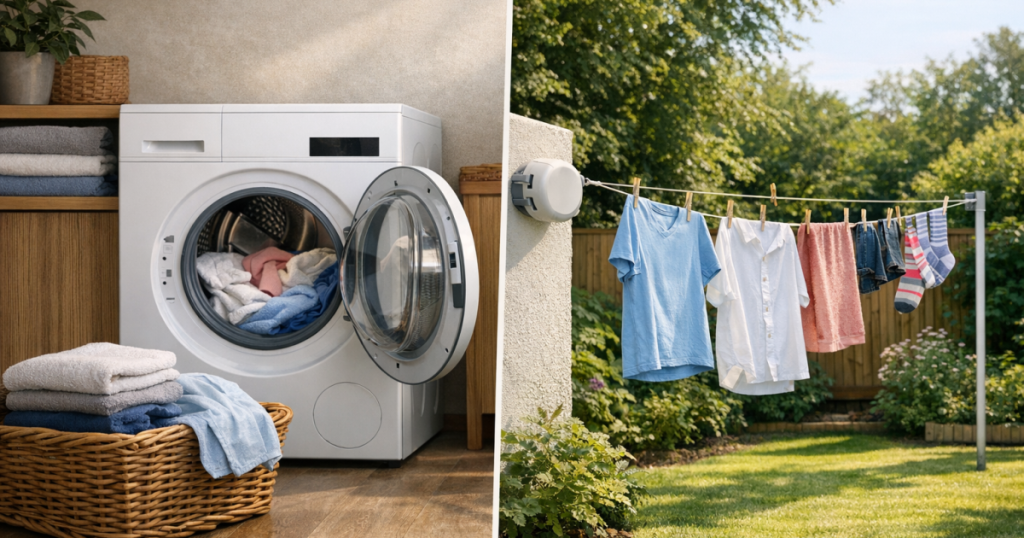
Drying laundry well in a British home is less about one perfect method and more about control, space and fabric risk. The choice between a heat pump dryer vs clothesline is really a choice between predictable indoor drying and low-energy air drying. A Bosch Series 4 Heat Pump Tumble Dryer suits homes that need repeatable results through wet weather, while a Minky Retractable Clothesline suits households that can give laundry enough airflow and time.
Quick Buying Links
Bosch Series 4 Heat Pump Tumble Dryer
A Bosch Series 4 Heat Pump Tumble Dryer suits homes that need repeatable results through wet weather, while a Minky Retractable Clothesline suits households that can give laundry enough airflow and time.
Minky Retractable Clothesline
A Bosch Series 4 Heat Pump Tumble Dryer suits homes that need repeatable results through wet weather, while a Minky Retractable Clothesline suits households that can give laundry enough airflow and time.
Both options can be fabric-friendly when used carefully. The wrong choice is usually the one that makes you rush drying, overload garments, or leave damp laundry hanging in still air for too long.
In brief
- Choose the Bosch Series 4 Heat Pump Tumble Dryer if you need reliable drying in winter, have limited outdoor space, dry uniforms or towels regularly, or want less dependence on the weather.
- Choose the Minky Retractable Clothesline if you want the lowest running cost, have a suitable wall or garden position, prefer gentler air drying, and can manage drying times around the weather.
- Use both if you can. A line is excellent for everyday cottons and airing, while a heat pump dryer is useful for towels, bedding, emergencies and damp weeks.
- Check garment care labels first. Some items tolerate low-temperature tumble drying; others are better dried flat, on a hanger or away from direct sun.
The two approaches are not solving the same problem
Bosch Series 4 heat pump tumble dryer
A Bosch Series 4 heat pump tumble dryer is a closed indoor appliance designed to remove moisture from laundry without needing a vent through an outside wall. Heat pump dryers generally use lower drying temperatures than traditional vented dryers, which can be gentler on many everyday fabrics, although cycle times can feel longer. Specific programmes, drum capacity, sensor drying behaviour and drainage options vary by model, so these details should be checked on the current product listing before buying.
The main benefit is consistency. If you wash work shirts on a Sunday evening, need school uniform turned round overnight, or live in a flat with no outdoor drying space, a dryer gives you a controlled plan. It also reduces the temptation to dry laundry over radiators, which can create local damp patches and poor airflow.
Minky retractable clothesline
A Minky retractable clothesline is a space-saving line that pulls out when needed and retracts when not in use. It is most appealing where a permanent rotary airer or fixed line would be awkward. Depending on the model and where you mount it, it may suit gardens, balconies, utility areas or sheltered indoor spaces, but you should verify the stated line length, maximum load, fixings and suitability for the place you intend to use it.
The biggest strength is simplicity. There is no electricity cost at the point of drying, no filters to maintain and very little to go wrong if the line is installed securely and used within its stated limits. The trade-off is that drying depends on air movement, humidity and time.
Side-by-side: what changes in everyday use?
- Drying speed: the Bosch is more predictable, especially in cold or damp weather. The Minky line may be fast on a breezy dry day, but slow indoors or during still, humid weather.
- Running cost: the Minky line has the advantage because it uses no electricity while drying. The Bosch uses electricity but may prevent repeat washing, musty smells and long indoor drying periods.
- Fabric wear: air drying is usually gentler for delicate fibres, prints and elastane. A heat pump dryer can still be suitable for many garments if the care label allows tumble drying and the right programme is used.
- Space: the Bosch needs a permanent appliance space, access to a socket and room to open the door. The Minky line needs secure fixing points and clear hanging space only when in use.
- Moisture control: the Bosch contains and collects moisture. A line used outdoors avoids indoor damp, but a line used indoors releases moisture into the room.
- Load handling: a dryer can handle full wash loads according to its rated capacity. A retractable line is limited by line length, fixing strength and the weight of wet laundry.
- Convenience: the dryer wins when laundry must be ready at a set time. The clothesline wins when you can let clothes dry naturally without pressure.
Fabric care: where each option protects clothes better
For cotton T-shirts, bedding, towels and many synthetic blends, either option can work. The deciding factor is not just the drying method but how you prepare the load. Shake garments out before drying, avoid twisting wet fabric tightly, and do not leave heavy items bunched together. Overloading either a dryer drum or a clothesline slows drying and increases creasing.
The Bosch is useful for towels, cotton bedding and robust everyday loads because it can finish drying when the weather is working against you. It may also help reduce the sour smell that develops when laundry dries too slowly. If odour is already a recurring problem after washing, drying method is only part of the answer; residues and wash temperature matter too, as covered in this guide to stopping work shirts smelling after washing.
The Minky line is kinder for garments that dislike heat or tumbling: lightweight viscose, embellished tops, bras, activewear with elastane, wool blends and anything marked to dry away from direct heat. For bras, hosiery and delicate trims, a line can still cause stretching if items are pegged badly while wet. Support the garment across more than one point, or use a drying rack for pieces that need to lie flatter. For small fragile items that do go through the wash first, choosing the right protection helps; see how to pick mesh laundry bags for delicates before they reach the drying stage.
Direct sunlight is another fabric issue. It can freshen whites and help outdoor laundry feel crisp, but it can also fade dark colours and some prints. If you plan to line-dry bright uniforms, black jeans or patterned shirts, test suspect garments before exposing them to sun and repeated washing. This is where a quick colourfastness test before washing can prevent disappointment.
Home fit in a UK laundry routine
In many GB homes, the right answer depends on property layout. A household with a utility room and regular full loads may get good value from a heat pump dryer. A small terrace with a narrow yard may find a retractable line more realistic than a bulky rotary airer. A flat with no balcony may need to think carefully before relying on indoor line drying, because moisture has to go somewhere.
If you dry indoors on a retractable line, ventilation matters. Open windows when conditions allow, use extractor fans in bathrooms or utility spaces, and avoid packing clothes so closely that air cannot move between them. Damp laundry in a closed room can lead to stale-smelling clothes and condensation on windows or walls.
A dehumidifier can make indoor air drying more controlled, but it is a separate purchase with its own running cost, noise level and water tank maintenance. If that route appeals, compare capacity, laundry mode, drainage options and room size carefully using these checks before buying a dehumidifier for laundry.
Effort, maintenance and hidden compromises
The Bosch is not maintenance-free. Heat pump tumble dryers typically need lint filters cleaned regularly, water containers emptied if not plumbed to drain, and heat exchanger or condenser areas cared for according to the manual. Skipping maintenance can slow drying and leave laundry less evenly finished. You should also check whether the model you are considering has dimensions that fit your space, including clearance for the door, ventilation around the appliance and access for emptying the water container.
The Minky line is simpler, but it still has practical limits. The line needs to retract cleanly, stay taut enough for wet clothing, and be fixed into a suitable surface. Overloading the line with wet towels, jeans or bedding can strain the mechanism or fixing points. Outdoor use also brings pollen, bird mess, wind-blown debris and sudden showers. These are not deal-breakers, but they mean line drying is not completely hands-off.
There is also the question of finish. A dryer can soften towels and reduce the board-like feel that line-dried towels sometimes develop. A clothesline can reduce creases in shirts and T-shirts if garments are shaken out and hung neatly. For woven shirts, drying on hangers can reduce ironing time; for heavy knitwear, hanging can distort the shoulders, so flat drying is usually safer.
Buying checks before you commit
If you are leaning towards the Bosch
- Check the exact model number. Series names cover more than one version, so confirm capacity, dimensions, energy label, programme list and control layout on the specific listing.
- Measure the route into the home. Do not only measure the final gap; check doorways, stairs and turns.
- Look at water handling. Confirm whether the dryer uses a container, offers a drain hose option, or needs any particular placement.
- Think about your normal loads. Towels, bedding and school uniform benefit more from predictable drying than occasional small hand-wash items.
- Read the care labels you actually own. If many garments say not to tumble dry, the dryer will still help with household textiles, but it will not replace air drying.
If you are leaning towards the Minky
- Check fixing surfaces. Brick, timber, fencing and plasterboard need different fixings and may not all suit the same load.
- Confirm line length and load guidance. Make sure it matches the washing you expect to hang, not just the space available.
- Plan airflow. A line in a sheltered corner may stay damp longer than one in a breezy position.
- Consider garment spacing. Leaving gaps between items often matters more than using every centimetre of line.
- Protect colours and trims. Dry darks inside out, avoid harsh midday sun for vulnerable colours, and keep embellished garments off exposed windy lines.
Which should you choose?
Choose the Bosch Series 4 heat pump tumble dryer if your main problem is reliability: wet weather, family laundry, towels, bedding, uniforms, limited outdoor space or a need to finish loads at predictable times. It is the stronger choice for convenience and moisture control, provided you are happy to give it permanent space and keep up with filter and water-container maintenance.
Choose the Minky retractable clothesline if your main problem is space and running cost rather than speed. It is the more fabric-gentle option for many delicate and heat-sensitive garments, and it makes excellent sense where you have a dry, airy position and can work around the weather. It is less suitable as the only drying method for households that need fast turnaround every week through winter.
For many UK homes, the most resilient setup is not either-or. Use the Minky line whenever weather and fabric type make air drying sensible, then use the Bosch for towels, bedding, urgent loads and damp spells. That combination gives you lower routine drying costs without leaving you dependent on a clear day.
Quick Buying Links
Bosch Series 4 Heat Pump Tumble Dryer
A Bosch Series 4 Heat Pump Tumble Dryer suits homes that need repeatable results through wet weather, while a Minky Retractable Clothesline suits households that can give laundry enough airflow and time.
Minky Retractable Clothesline
A Bosch Series 4 Heat Pump Tumble Dryer suits homes that need repeatable results through wet weather, while a Minky Retractable Clothesline suits households that can give laundry enough airflow and time.
Things readers ask
Is a heat pump tumble dryer gentler than a normal tumble dryer?
Generally, heat pump dryers use lower drying temperatures than traditional vented dryers, which can be kinder to many fabrics. Always check the garment care label and the programme details for the exact dryer model.
Can I use a retractable clothesline indoors?
You can if it is fixed securely and the room has enough airflow. Indoor line drying releases moisture, so ventilation or dehumidification is important to avoid condensation and musty laundry.
Will line drying make towels hard?
It can, especially in still air or when towels dry very slowly. Shaking towels before hanging helps, but a tumble dryer usually gives a softer finish.
Which option is better for delicate clothes?
A clothesline or drying rack is usually safer for delicate, embellished, wool-blend or elastane-rich garments. Use the dryer only when the care label allows it and select an appropriate low-heat or delicate programme where available.
Do I need both a dryer and a clothesline?
Not always. If you have predictable outdoor drying space and flexible laundry timing, a line may be enough. If you need regular fast turnaround, a dryer provides useful backup.