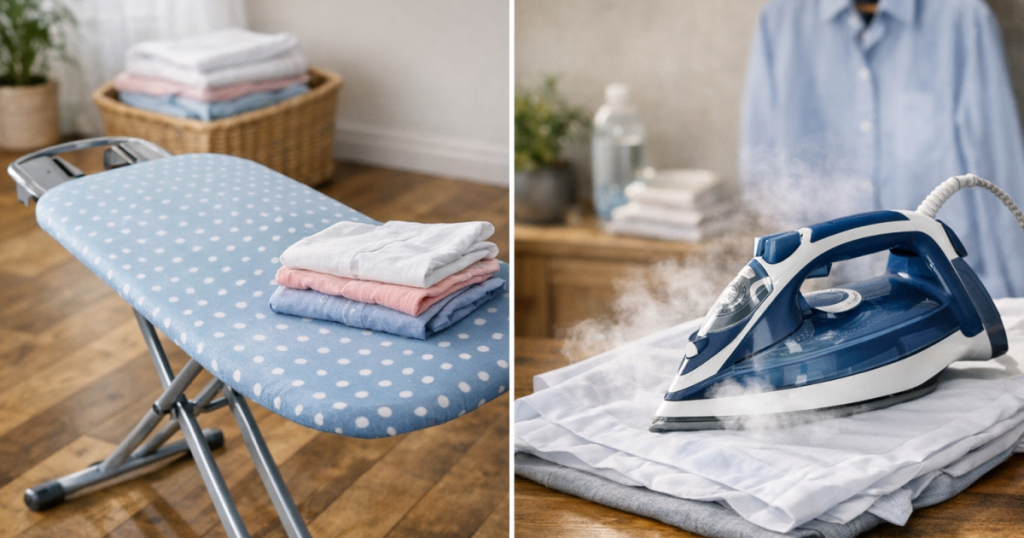
Minky Homecare Ironing Board vs Tefal Steam Iron FV4970 is not a straight like-for-like choice. One gives you a better working surface; the other supplies the heat, steam and pressure that remove creases. The more useful upgrade depends on what is currently slowing you down: a wobbly, poor-cover board, or an iron that struggles with cotton shirts, uniforms and household laundry.
Quick Buying Links
Minky Homecare Ironing Board
Minky Homecare Ironing Board vs Tefal Steam Iron FV4970 is not a straight like-for-like choice.
Tefal Steam Iron FV4970
Minky Homecare Ironing Board vs Tefal Steam Iron FV4970 is not a straight like-for-like choice.
For many UK homes, the best result comes from matching both well rather than expecting either item to do all the work. A good iron can still drag on a thin, uneven cover. A good board cannot rescue an iron that leaks, spits, catches on seams or fails to maintain a smooth finish.
At a glance
- Choose the Minky Homecare Ironing Board if your current board rocks, sits at the wrong height, has a tired cover, or leaves button plackets and trouser seams awkward to handle.
- Choose the Tefal Steam Iron FV4970 if your board is stable but your iron is the weak point, particularly on cotton, polycotton school shirts, workwear and bedding.
- upgrade the board first if you notice fabric distortion, shine from over-pressing, or frustration when manoeuvring garments.
- upgrade the iron first if creases remain after repeated passes, steam feels inconsistent, or the soleplate does not glide cleanly.
- Check the current product listing before buying either item, as board size, cover type and iron features can vary by retailer description and package.
What each product actually solves
The Minky board is part of the ironing setup: it affects posture, support, garment positioning and how safely you can press around seams, cuffs and collars. It does not remove creases by itself, but it changes how efficiently the iron can do its job.
The Tefal FV4970 is the active crease-removal tool. It applies heat and steam to relax fibres, while the soleplate and your hand pressure smooth the fabric. Its value is clearest when the old iron is the reason you keep going over the same area.
That difference matters because ironing problems are often misdiagnosed. A shirt that still looks rumpled may be suffering from a weak iron, but it may also be sitting on a board cover that compresses unevenly. A pair of work trousers may need better pressing support along the crease line before any iron upgrade feels worthwhile.
Side-by-side comparison
- Main role: The Minky board improves the surface and working position. The Tefal FV4970 provides the heat and steam for crease removal.
- Best improvement area: The board helps with stability, garment handling and pressure distribution. The iron helps with steam performance, glide and finishing speed.
- Most noticeable on: The board is most noticeable with shirts, trousers, bedding and larger garments that need space. The iron is most noticeable on stubborn creases, collars, cuffs and heavier cottons.
- Fabric-care risk: A poor board can encourage over-pressing because fabric is not supported evenly. A poor iron can cause dragging, water marks or excessive heat exposure if you repeatedly attack the same crease.
- Storage impact: A full-size board needs somewhere sensible to stand or hang. A steam iron takes less space but still needs safe cooling and storage after use.
- Running routine: The board affects the comfort of every ironing session. The iron affects the finish of every garment you press.
- What to verify before buying: For the board, check dimensions, height adjustment, cover construction and storage fit. For the iron, check the retailer’s stated steam controls, soleplate description, anti-calc care, cord length and water tank arrangement.
Where the Minky Homecare Ironing Board has the advantage
A better board can make ironing feel less like a fight. If your current board dips in the middle, flexes under pressure, or has a cover that has gone thin and shiny, you will not get the best from any iron. The fabric needs a smooth, lightly cushioned surface so steam can work through the fibres without creating new ridges.
The board upgrade is particularly persuasive for households ironing several school shirts, work shirts or uniforms at once. Larger flat areas are easier to position, and the right height can reduce the temptation to lean heavily into the iron. That matters for fabric care because too much pressure, especially with heat, can flatten texture and create shine on darker trousers.
It also helps when you are trying to press details neatly. Button bands, collars, cuffs and trouser seams all benefit from a stable surface. If the board is moving, your hand tends to compensate with extra pressure, which can be rough on viscose blends, dark polycotton and delicate trims.
The trade-off is simple: an ironing board will not improve steam output or fix a poor soleplate. If your iron is unreliable, leaks, or struggles to smooth cotton even on a good surface, the board may make the routine nicer without solving the finish.
Where the Tefal FV4970 has the advantage
The Tefal Steam Iron FV4970 is the more direct upgrade if creases are the main frustration. A steam iron is what relaxes fibres, tackles folds and gives shirts, blouses and household linens their cleaner finish. If your board is already firm and level, a more capable iron will usually make the bigger visible difference.
Pay attention to the types of clothes you press most. Cotton shirts, school uniform, workwear and bedding usually benefit from steady steam and a smooth soleplate. Synthetics and blends need more restraint, so adjustable heat and careful fabric sorting matter as much as raw crease-removing power.
For viscose, satin-effect fabrics or anything with a low-heat care label, the issue is not simply which iron is stronger. It is whether you can use heat gently enough. If you regularly refresh viscose dresses or blouses, compare ironing with steaming before pressing directly; our guide to whether a garment steamer or steam iron is safer for viscose explains the fabric-care trade-off in more detail.
The limitation is that a steam iron still needs support. On a sagging board, steam can condense into a tired cover, seams can imprint where you do not want them, and garments can slide just as you are trying to create a sharp finish.
Fabric results: shirts, trousers, bedding and delicates
Shirts and school uniform
If collars and cuffs are the problem, the iron has more influence because heat and steam soften the firm layers. If the body of the shirt is difficult to keep flat, the board becomes just as important. A stable ironing surface lets you work panel by panel instead of chasing wrinkles around the garment.
Work trousers and darker fabrics
Trousers need controlled pressure. The board helps you align seams and avoid accidental creases, while the iron determines how cleanly the crease sets. Use a pressing cloth on dark or shine-prone fabrics, and do not keep increasing heat simply because a crease is stubborn. If the trousers are stained before ironing, treat them first; heat can make marks harder to shift. For oily marks, follow a proper method such as this guide to removing grease stains from work trousers.
Bedding and larger items
A board upgrade is often more noticeable for bedding because support and space matter. The iron still does the smoothing, but a narrow or unstable board makes duvet covers and pillowcases awkward. For larger items, the time saving may come from easier handling rather than a more powerful iron.
Delicates and textured fabrics
Neither product should be treated as a licence to press everything aggressively. Lace, embroidery, pleats and textured knits need lower heat, less pressure and sometimes no ironing at all. Use the care label as the starting point, test inconspicuously where sensible, and consider steaming from a distance rather than pressing directly.
What to check before you buy
Because retailers may describe bundles and variants differently, compare the current listing carefully rather than relying on assumptions. For the Minky board, check the working surface dimensions, height range, frame stability, cover material and whether replacement covers are easy to source. Think about where it will live when folded; a board that is annoying to store is less likely to be used.
For the Tefal FV4970, check the stated steam settings, temperature controls, water filling method, anti-calc maintenance and soleplate description. Also consider the weight when full, because an iron that feels tiring may encourage rushed technique. If you live in a hard-water area, anti-calc care is worth taking seriously; limescale can affect steam performance over time.
It is also worth comparing nearby Tefal models if you are not fixed on the FV4970. For example, the Tefal Ultraglide Anti-Calc Plus FV5872 review gives you another point of reference for what to look for in steam control, maintenance and everyday usability.
Buyer guidance: which weak point is costing you more time?
Choose the Minky board if your ironing sessions feel physically awkward. That means the board moves, the height is wrong, garments drag on the floor, or you struggle to position sleeves and trouser legs. In those cases, the board upgrade improves the whole workflow, even if your current iron is acceptable.
Choose the Tefal iron if the visible finish is the issue. If you are already using a stable board but still need repeated passes on shirts and bedding, the iron is more likely to be the bottleneck. A smoother, more consistent iron can reduce overworking, which is better for both time and fabric longevity.
Do not ignore drying before ironing. Clothes that are over-dried can be harder to smooth, while clothes that are too damp can feel limp and slow to finish. If you air dry most laundry, choosing the right spin speed before air drying can make the ironing pile easier before either product comes out.
Which upgrade should you make first?
If you can only buy one, start with the part of your setup that is clearly failing. A stable, well-covered board is the foundation for neat pressing, so the Minky Homecare Ironing Board makes sense when your current board is flimsy, uneven or uncomfortable. It is the more practical first purchase when handling, posture and garment positioning are the daily irritations.
The Tefal Steam Iron FV4970 is the stronger first choice when your existing board is sound but your iron is holding back the finish. It is the more visible upgrade for stubborn creases, shirt collars, uniform and bedding, provided you use the right heat setting for each fabric and maintain the iron properly.
For the neatest results, treat them as a pair rather than rivals: the board creates the surface; the iron creates the finish. If one is poor, the other has to work harder. If both are well matched, ironing becomes faster, gentler and more predictable.
Quick Buying Links
Minky Homecare Ironing Board
Minky Homecare Ironing Board vs Tefal Steam Iron FV4970 is not a straight like-for-like choice.
Tefal Steam Iron FV4970
Minky Homecare Ironing Board vs Tefal Steam Iron FV4970 is not a straight like-for-like choice.
FAQ
Is it better to upgrade an iron or ironing board first?
Upgrade the item that is causing the obvious problem. A wobbly board should be replaced before chasing a better iron. If the board is stable but creases remain, upgrade the iron first.
Can a better ironing board reduce shine on clothes?
It can help by giving fabric more even support, but shine is mainly caused by excess heat, pressure or direct contact. Use lower heat and a pressing cloth on dark or delicate fabrics.
Is the Tefal FV4970 suitable for all fabrics?
No steam iron is suitable for every fabric at one setting. Always follow the garment care label, reduce heat for synthetics and viscose, and avoid direct pressing on delicate trims.
Do I need a special cover for a steam iron?
You need a cover that is smooth, secure and suitable for steam use. A worn, thin or loose cover can make pressing less even and may leave impressions on garments.
Should clothes be fully dry before ironing?
They should usually be dry or very slightly damp, depending on the fabric. Over-dried cotton can be harder to smooth, while overly damp garments can take longer and may lose shape.